Chuck Wendig: Terribleminds

Apple-Obsessed Author Fella

Archives (page 290 of 480)

C. Robert Cargill: The 36th Chamber of Wri-Tin (Or: “Welcome to the Wizard’s Tower”)

Cargill’s one of those writerly bad-asses you hear about. Disgustingly talented, show-offingly able to jump from talking about film (Ain’t It Cool News) to actually writing films (Sinister) to writing books (Dreams & Shadows). We should probably throw things at his head or, failing that, actually listen to what he has to say. Let’s try the last one first, see how that goes. Here he is to talk about the writer’s career and how it leads to his newest, Queen of the Dark Things.

When I was 11 years old, my parents signed me up for self-defense classes. I was your typical nerd/geek/dork hybrid with a loud mouth, few social skills, and had sprouted up half a foot taller than my classmates a few years too early, making me the perfect target for any bully worth his salt trying to make a name for himself. “Hey! You with the book! Get over here!” My parents were tired of me losing so often, so they dragged me to the nearest gym and signed me up. What they didn’t know was that they weren’t signing me up for any mere “self-defense” course. They were signing me up for Shotokan Karate, taught by a traditionalist master who had come back from ‘nam with a knee shredded by a bullet which he’d had rebuilt after being told he’d never walk without a cane again before recovering and becoming one of the highest ranking Shotokan black belts in the United States.

Yeah. He was a bad ass. And I got a lot of life lessons out of that guy. A LOT of life lessons.

The first thing he taught me came on the very first day of class. “Every week there’s some knucklehead who walks in here thinking he’s going to be Bruce Lee after a couple of lessons,” he said. “And every week that guy leaves after a few classes pissed off because I wasn’t good enough of a sensei to do that. So if you’re the guy who thinks he’s going to wake up fighting like Bruce Lee tomorrow morning, the door is over there. Leave now and don’t waste my fucking time. If you stick with this for a few weeks, I’ll teach you how to throw a decent punch. Stick around for a few months and you’ll be able to hold your own in a bar fight. Stick around for a few years and I’ll teach you things to make sure you never have to lose a fight again…or even have to fight one to begin with. But Bruce Lee? Almost no one ever gets that good, and when they do, it takes a lifetime.”

He was right. I never became Bruce Lee. But I stopped losing fights and eventually had won enough – and learned enough – that I never had to fight again. And 25 years later, I still haven’t.

I mention all this because every few weeks or so I run across an impatient young writer asking for advice about publishing. When pressed about their desperation, their response is almost universally the same. “I need my career to start now, not a year from now,” they say. “I’ve got bills to pay and I don’t want to wait for success. A year is a long time! And it could take even longer than that! That’s just the average!” When you ask them who they want to be, they rarely answer small. Sure, you’ll occasionally run across someone who says, “Oh, just a mid-lister with a respectable following that has to work part time to pay the bills.” But most of the time you hear “I want to be the next George R.R. Martin! Or J.K. Rowling! Or Neil Gaiman! Or Kurt Vonnegut! Or Charlaine Harris! Or Stephanie Meyer! Stephen King! Isaac Asimov! Kim Harrison! Ray Bradbury! Brandon Sanderson!”

You know. The bestsellers. The kung fu masters. The grand wizards. Bruce. Fucking. Lee.

Almost none of those names hit the jackpot with their first book. And none of them did it overnight. Few writers that get early, big success actually maintain that notoriety and position for long periods of time. And there’s a reason for that. The career of a writer isn’t analogous to that of any other entertainer; it is its own beast entirely.

In other entertainment careers, one great season, hit single, album or movie can make your career. But athletes only get from their teen years to their early thirties to make their mark. Same goes for pop stars and actresses. Actors and Rock Stars tend to start a little later – in their late 20’s – and get until their early 40’s to try and make it. And you can count on one hand the number of people who ever make it past those limits. But writers? Writers are different.

Writers are more like Kung Fu masters or fantasy wizards. We’re all genre fans here. Think about every great martial arts or fantasy epic you’ve ever seen or read. How does it start? Someone kicks in the gates of the martial arts monastery/wizard school/MFA program at age 19, fresh faced, full of piss and vinegar, ready to show the masters what for, and they declare at the top of their lungs “I am going to be the greatest kung fu master/wizard/writer who has ever lived!” And the students around them all laugh. The teachers roll their eyes. But the long bearded master in back, the one everyone fears, who passes down nuggets of wisdom wrapped in enigmas, who has battled countless foes, slain numerous dragons, published bestselling epic tomes of repurposed bronie slash-fic in iambic pentameter – he just strokes his beard, smiles and mutters “We shall see, young one. We. Shall. See.”

You see, the master knows that every Kung Fu master/wizard/writer has kicked those doors in saying the exact same thing. Sure, most that try fail, give up, get a day job while dreaming of what might have been – the styles they might have bested, the dungeons they might have purged, the awards they might have won, movies and TV series they might have spawned. But the ones who stick around learn that no master becomes so overnight. First they have to learn how to throw a decent punch or magic missile. Then they learn how to hold their own in a bar fight/tavern brawl. Soon, after years of practice, they learn how to win most of the fights they get into. And it is only then that their legend begins to grow.

The career of a writer isn’t about one fight or one dragon; it is about a career full of fights and dragons. Of victories and defeats. Of good books and bad. Of acceptance and rejections. Bestsellers and flops. Cancelled television shows and movies put into turnaround. It is about getting into anthologies only to find your name on the cover listed as “and many more!” It is about doing that for a few more years until your name actually makes the cover of the anthology…as filler between more recognizable names. Soon, if you keep writing, keep publishing, your name *is* one of the recognizable ones on the cover. And after a decade or two of work, your name might even make top billing. But not right after your first fight, or zorching your first skeleton, or writing your first novel.

Unlike almost every other entertainment career, age is not your enemy, but your ally. There’s a reason the New Yorker publishes its “20 under 40” and not “20 under 20.” The fresh faced martial artist or wizard isn’t the one to be feared or admired – it’s the wizened old bearded one in back, chuckling to himself. It’s not the 16 year old George Raymond Richard Martin who bought the first ticket to the first comic con in 1964 and frequently wrote letters to the editor at Marvel and articles for fanzines; it’s the George R.R. Martin who fifty years later, despite losing out on many of the major awards he’s been nominated for, who despite writing for short-lived TV show after short-lived TV show, whose novel A GAME OF THRONES didn’t become a #1 NYT bestseller until 15 years after publication, who has a backlist so long that virtually no one reading this has read it all, who can’t even attend comic con anymore without a security detail just to get from one side of a room to the other. It’s the Stephen King who was bagged on by critics for thirty years until he had written so many good bestsellers that they couldn’t argue with the mound of success he was standing on and had to declare him one of the greatest – not only of his generation, but of all time. It’s the Isaac Asimov with his name on over 500 books. Full stop.

That’s the guy you watch out for.

That’s Bruce Lee. Wong Fei-Hung. Fong Sai-Yuk. Gandalf. Merlin. Morden-fucking-kainen. Being a writer isn’t about writing one great book. It’s about writing 20 good ones…and maybe three or four great ones…if you’re lucky. That’s the job. That’s the career. It requires patience. It requires devotion. It requires decades of sleepless nights curled into a ball asking yourself what the everloving fuck you are doing with your life. There’s nothing wrong with wanting to be that kung fu master, to be that wizard. You just have to think about it that way.

Blazing a career as a writer isn’t about where you’ll be next year; it’s about where you’ll be in five, ten and twenty. Are you a talented 16 year old with your own ideas for becoming the next George R.R. Martin? What are you doing for the next fifty years? Because *that’s* what you need to be thinking about. No career requires nearly as much devotion and time to develop, but none pays out such dividends for so long either, or affords so many chances to get it right. Maybe, if you’re lucky and play your cards right, some day you too might have fans walk up to you on the street and ask you not to die until you finish your latest opus. But you’ve got time; you’ve got a lot of living to do between now and then. A lot of fights to win, dragons to slay, knees to get shredded in ‘nam. That’s the career you’re embarking on.

Welcome to the monastery. We all want to be Bruce Lee here. And that’s okay. But if you’re not ready to put in the time, if you think it is going to happen overnight, the door is over there.

C. Robert Cargill: Website | Twitter

Queen of the Dark Things: Amazon | B&N | iTunes | Indiebound
In Fiction, Nothing Is Forbidden, Everything Is Permitted

In other words: “Fuck the rules.”

WHOA, JEEZ, ME. SLOW YOUR ROLL, WENDIG.

Okay, so, at cons and conferences — or via e-mail — someone inevitably mentions in a question something that writer is “not supposed to do.” This person has been reliably and repeatedly informed at some point that This Particular Thing is Fucking Anathema, a Dealbreaker Of Epic Narrative Proportions, and to Do This Shitty Thing is Tantamount To Kicking A Baby Down A Flight Of Steps Into A Pile Of Burning Books. (No, I don’t know why I capitalized a bunch of those words, but it felt good at the time. This is probably appropriate given the post I am about to write.)

This can be anything, really.

Don’t open on weather.

Don’t open with a character looking in a mirror.

Don’t open on a character just waking up.

Never ever use an adverb ever.

(Related: “In Writing, There Are Rules, And Then There Are Rules.”)

And for all that’s fucking holy, writing a prologue is a major biggum no-no, on par with and as pleasant as prolapsing one’s anus. You may in fact be told that a Prologue killed Jesus in the Gospel According To… I don’t remember. Dave, maybe. Dan? Eh.

Point is: Somewhere, you’ll find a list of prohibitions that some writer somewhere decided was an official bad idea. This is maybe a published writer. This is maybe just some yahoo.

But what I want you to realize is this: for every prohibition made, for every supposed forbiddance, you will find a book that defies that supposed dictum. Not just a book — you’ll find a published book. A good book, too. Maybe one that sold a metric keister-load of copies. For every rule, many notable exceptions to that rule.

I mean, okay, I dunno how good it is, but I wrote Blackbirds by breaking a ton of these narrative norms and storytelling mores, these purported prescriptions. I open with a character looking in the mirror. It’s present tense, but third person. It’s a mish-mash of genres: frog-hopping from horror to crime to urban fantasy. I use lots of dream sequences and flashbacks. I wrote a theoretically unlikable character (though I prefer to think of her as quite lovable just the same, but then again, I’m kinda goofy). I actively and openly wanted to defy rules.

Hell, pick up a bunch of genre books and you will find contained with them a — drum roll please — prologue. Despite its reported Jesus-killing powers, the prologue continues to pop up like an errant credit card charge, like a bad smell, like the aforementioned prolapsed anus. Prologues are like a dietary restriction that we say we don’t wanna eat and yet there we are, gobbling the damn things down like we don’t care if we end up with a barely-chewed kielbasa clogging our aorta.

It is with this you need to realize:

This is your story.

It’s your book.

You can do whatever the flippy, floppy fuck you want.

Nothing is forbidden. Everything is permitted.

If you listened to every prohibition out there about writing, you’d be trapped in so tight a box I’m not sure you could even write a story at all. You’d probably just be writing the repair manual for a 1990 Geo Tracker.

With this, I offer two very important caveats:

First, just because everything is permitted doesn’t mean everyone likes those particular things. Some agents and editors — if you are going that route — will immediately throw the Kill Switch upon seeing one of these boogers appear. “She began her story by addressing the reader,” the editor says, then promptly spaces the manuscript through the merciless mouth of her spacecraft’s airlock. (All editors live in spaceships floating above the dystopian island of Manhattan. I originally thought this was to protect them from Amazon in a kind of Reagan-era defense program, but now I think it’s just because: hey, spaceship.)

Second, if you are going to break any of these prohibitions, know that they exist for a reason. Defying them is meaningful — an act of rebellion that says two things: one, “I don’t give a shit about your rules,” and two, “I am good enough to step on them and break their little bones.” Your contravention of expectation — your demand to be an exception — has to be one made of great effort and skill. Most prologues? They’re dogshit. That’s why everyone hates them, because people tack them on not because it’s essential to the tale but because they saw some other asshole do it and they thought, “I dunno, it’s a trope?” Like they’re checking a checkbox. People who overuse adverbs are frequently amateurs. People who start with weather do so not because the weather is essential to convey something about the plot, or the setting, or to lend us mood, but rather because the storyteller doesn’t know what the fuck to talk about. “I dunno — uhhh. The sun… is up? But a storm is… coming? Wait, is there supposed to be something relevant here?”

Do not ignore the prohibitions.

Know them.

And give them the middle finger when and only when you know why you need to go the other way. Nothing is forbidden, but a whole bunch of shit isn’t particularly recommended, and when you decide to walk the challenging path — when you pull a stunt — you better own it, and rock it like only you can. Write with purpose and awareness. It’s your story. So know why you’re making the choices you’re making. That is the way of the wise storyteller.

* * *

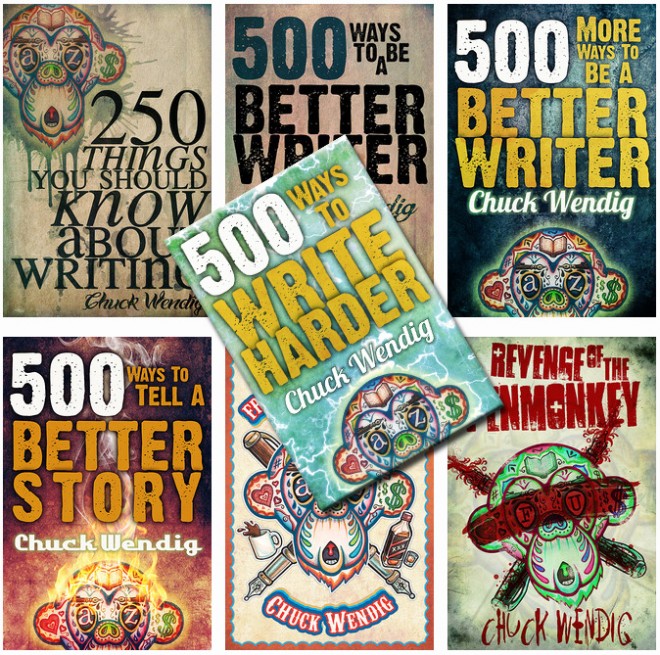
The Gonzo Big Writing Book Bundle.

*pay what you want, starting @ $10*

Flash Fiction Challenge: Must Contain This Sentence…

Last week’s challenge: “Behold Your Theme.”

Here, then, are three random sentences:

“The borderlands expire thanks to the hundred violins.”

“A poetic pattern retains inertia.”

“The criminal disappears after the inventor.”

That’s it.

I generated them randomly, online.

You will choose one of these three sentences and include it in a piece of flash fiction, maximum of 1000 words. (For bonus kudos, use all three sentences in one story. Ooooh.)

Due by this Friday, the 16th, noon EST.

Post at your blog.

Drop a link to it here so we can all see it.

Go forth and write!

Hive-Mind As Story Doctor

(For those asking, sadly the flash fiction challenge on Friday failed to post! Actually it failed to save and I never noticed — been having some up-and-down website issues since last week and I think this was a result of that. Since I was in Canada with limited access to the web, hard to do much about it. As Canadians would say — sooorry! I’ll get one up later today.)

Here’s where I ask you:

How’s the writing going?

What problems are you hitting?

Not only does this give me stuff for future blog posts but it lets the rest of you fine folks here act as a hive-mind to discuss how you might solve a problem. This is less about me helping you today and more about you helping one another. In a weird way, terribleminds has become a kind of community of penmonkeys these days, right? So, hell, let’s use that.

Need advice on writing or storytelling, ask.

And check out the other comments, see if you can offer advice of your own.

Do this, or you will all get the hose.

And by “hose,” I mean, “upended basket of rabid ferrets.”

Jason Rohan: Five Things I Learned Writing The Sword Of Kuromori

Ancient monsters bite off more than they can chew in this action-packed adventure set in modern Japan.

Kenny Blackwood, aged 15, arrives in Tokyo to spend the summer with his estranged father only to find himself in the middle of a hidden war that is about to explode.

Racing against a near-impossible deadline, Kenny must find Kusanagi, the fabled Sword of Heaven, and use it to prevent the disaster. But a host of terrifying monsters is out to destroy him, and success will come at a price.

With the clever, fearless Kiyomi as his guide, Kenny must negotiate the worlds of modern and mythic Japan to find the lost sword, before it’s too late.

***

A MILL NEEDS LOTS OF GRIST

Ah, that old chestnut, “plenty of grist for the mill.” It’s a good plan; if you’re going to write, it helps if you live a bit, else what are you going to write about?

At the simplest level, I take this to mean try as many new experiences as you can. Try bungee-jumping – you might have a character fall from a great height. Try learning a new language – you’ll see the limitations of your own as well gain insight into another way of thinking.

Or you can push it to the extreme and snack on hallucinogenic mushrooms or wear a Ku Klux Klan costume to a hip-hop concert. Whatever you’re willing to risk, but the point is the same: try new experiences, because you never know when it will come in useful.

Taking a step back, I also apply this to leaving one’s comfort zones. Watch a movie, read a book, or listen to an album that you’d normally go nowhere near. It’s a good lesson in analysing why the particular piece doesn’t work for you, but also you might get an idea from it, however small, in which case it wasn’t a wasted exercise.

FEAR IS THE PATH TO THE DARK SIDE

Without getting all Freud-dude about this, we all have at least two selves. One passes for normal and is sensible; this is the self that functions in society, wears matching socks and knows how to queue. The other is a headcase; this is the self that wants to walk out of the house naked, to jump in front of a train, to fart in a crowded elevator. That other self is a dick – we know this – and if given control will kill us, which is why we have the Darwin Awards.

But here’s the thing; that other self has its uses and one of those is to make us chase opportunities. Nice Christopher Columbus probably wanted to stay home and play with kittens, but it was Nasty Christopher Columbus who sailed to the New World, caused mass genocide and ultimately gave us the internet which is how you’re able to read this. Sure, we can play it safe, but then we don’t achieve anything.

You have to take risks if you want to get anywhere, whether it’s the grocery store or the Hugo Awards. In my case, I went to Japan, fresh out of college, without speaking a word of Japanese. It was a life-changing decision, the best thing I did, but it wasn’t Mr Safe who made the call.

SKELETONS HAVE THEIR USES

I long ago came to the conclusion, maybe wrongly, that everyone has scars from childhood. I even picture some Mitt Romney-type, silver-spoon-in-the-mouth, trust fund beneficiary sitting in his shrink’s office bemoaning the fact that his life was too sheltered, devoid of any character-forming challenges and he’s an emotional wreck as a result.

We all have scars, skeletons in the closets, bodies under the floorboards. That’s not a bad thing at all.

I have a somewhat unusual background, being born in England to Caribbean immigrants of Indian origin. (Think AMA award-winning Nicki Minaj or Nobel Prize laureate V.S. Naipaul, depending on your cultural proclivities.) Growing up in the Seventies, this meant I experienced racism and prejudice, but that’s life. As a teenager, I had a serious battle with depression after my father died, but again that’s all valuable grist. No experience is ever wasted provided you learn from it and this is where “write what you know” comes into play.

All stories, the ones written by humans at any rate, have characters with feelings and emotions that we all share and understand. The stronger the bond of empathy between character and reader, the more engaged the audience, and one way to do that is to unearth some of those skeletons.

When I came to write this book, I wanted the character arc to include a reconciliation between father and son and the way I approached it was to have that conversation with my own long-deceased father, to say some of the things I should have but never did. Yes, it was uncomfortable, picking at old scabs, but also therapeutic and, I hope, infuses some emotional authenticity.

BEING A STUBBORN S.O.B. ISN’T A BAD THING

Being a writer is a vocation. Like the priesthood, it requires sacrifice, dedication and faith. Unlike the priesthood, there is no promise of reward nor grateful parishioners. You’re on your own, sweetheart, and all you have to keep you going is blind faith in your own abilities.

This is easier to manage if you’re a raging egomaniac but, if not, then stubbornness isn’t a bad back-up trait.

The Sword of Kuromori is the third book I wrote but it’s the first one I sold. Back in 2007, when I started writing seriously again, the first fruit of my labours was a 144,000-word monster which I quickly buried without ever sending off to anyone.

It was too long for a debut novel and needed a lot of rework, but it was finished and I’d learned so much from writing it. For a complete break, I next wrote a fast-paced, action thriller for my kids. It got me an agent but not a publisher. I then wrote Kuromori but it took me a year and a half to find a new agent, during which time I went and wrote a fourth book, to keep me from fretting.

Once I landed my new agent, the book was sold four months later, but it took six years, four books, two agents and 78 rejections to reach that point.

The funny part is that I’d set myself a target of 200 rejections before I quit and moved on to another book, so I came in under the line.

RESEARCH IS GOOD BUT WHEN IT FAILS MAKE STUFF UP

I spent five years in Japan, which is why it was a natural move for me to set the novel there. Having said that, it’s been a while since I left and I’d never studied Japanese myth or folklore so I had a lot of homework to do, both directly for the novel and indirectly to re-familiarise myself with the language, customs and traditions.

Fortunately, thanks to the power of the internet, I could do a lot of that on my PC, such as using Google Street View to tour the back alleys of Tokyo. Nonetheless, it still took over a year of digging to gather the material I needed for the tale, but what do you do when you can’t find that elusive kanji or obscure god you came across in the Kojiki?

For me, that was easy. A fiction writer is by definition a liar. Plato wanted to banish all poets from his idealised Republic because as soon as you say, “There was once a man who had two sons,” you’re making stuff up and lying your ass off.

In this light, it then becomes simple to create the things you need, as long as you play by the rules of your world. For example, I created a system of using magic by writing out Chinese logographs in the air. It seemed to make intuitive sense to me and I later discovered folk tales in which that happened. Similarly, certain types of Japanese monster follow patterns, such as the chimera-style transposing of one type of head on to another body. Knowing that gives me licence to create new beasties if I can’t find one that serves the story’s purpose.

For me, research is still king and will often dig you out of a hole, but don’t become a slave to it. The beauty of writing fantasy is that no-one can really bust your nuts over it, not anyone sane at least. “But a real wizard wouldn’t do that,” isn’t going to carry a lot of weight. So long as you stay true to the spirit of the world you’re working in, you’re free to create anew.

Here’s a final example. I wanted to include a variation on the “five finger death punch” because, hey, it’s a kid’s book with martial arts and it’s really cool, but I couldn’t find any solid references in the literature, so I made it up. Enjoy!

“The remaining oni stopped to size up the frail-looking old man. Genkuro bowed to the creature and then adopted a fighting stance. The monster grunted and smashed at him with its club. Genkuro’s left hand flashed upwards and he parried the blow, blocking the huge metal beam with his bare hand. With his right, he landed a chop on the oni’s wrist.

Kenny winced at the sound of bone snapping and stared as a ripple went up the oni’s arm. The staccato sound of crackling bone continued as the shock wave travelled to the monster’s shoulder, along its rib cage and down its spine. The oni flopped to the ground, its body reduced to a large bag of skin, as its pulverised skeleton could no longer support it.”

***

Jason Rohan has worked as a staff writer for Marvel Comics in New York and as an English teacher in Japan, where he lived for five years.

Jason Rohan: Website | Twitter

Sword of Kuromori: Amazon | B&N | Kobo | Powells