Chuck Wendig: Terribleminds

Apple-Obsessed Author Fella

Archives (page 289 of 480)

These Lettuce Wraps Will Ruin You For Other Food Oh Well Sorry

Evil Twin

It’s been a while since I’ve abused you with a recipe and now I’ve been drinking and the alcohol demons inside my belly are whispering up through the shattered fissure of my acid-scorched esophagus and they are humming IT IS TIME IT IS TIME AGAIN TO PUNISH YOUR READERS WITH A SURLY, PROFANE-LADEN RECIPE FROM BEYOND HELL’S OWN CRADLE and so fuck it, here I am, telling you how to make chicken lettuce wraps.

Okay, I’ll admit, that doesn’t sound particularly bad-ass.

“Lettuce Wraps.”

Is it possible to say that in a bad-ass way?

Like, LETTUCE WRAPS, ALL CAPS, GROWLED IN A CANCEROUS WAY.

Still not really, no.

Maybe it needs rebranding. A new name.

LEAF CUPS.

Yeah, no.

LA LECHUGA DEL DIABLO.

Getting closer.

HEAD-SKIN OF THE GREEN MAN FILLED WITH HOT MINCED COCK.

Maybe?

Whatever, you know what? This will be so good, it doesn’t need a kick-ass name.

It just needs kick-ass flavor, and the way we do that is with a moist, steaming dollop of Guy Fieri’s DONKEY SAUCE. Ha ha ha, no, seriously, kids, don’t put anything Guy Fieri touched on your food, it’ll taste like those weird exxxtreme pubes he has on his face. That’s what those are, right? He just glues his dyed pubes up there around the taco-hole he calls a mouth?

Hm.

Let’s talk about this food, and not Guy Fieri’s crotch-face.

This recipe is very customizable.

I prefer a life with options, and I like my recipes the same way. I don’t want to just follow an obvious list of ingredients and measurements. I want the freedom to choose, say, BISON GONADS instead of CHICKEN THIGHS. Because this is America and our freedom is so free it’s basically obscene so why not revel in it? If I want to use cabbage instead of lettuce, who will stop me? You? WHO RUN BARTERTOWN? MASTER CHUCKSTER RUN BARTERTOWN. LIFT EMBARGO.

Man, I’m starting to think that drinking during these recipes isn’t best.

Welp, too late.

Let’s get on with it.

You’re going to need:

SOME KIND OF LETTUCE. It needs to be the kind of lettuce you can fold up like a little botanical taco, a little purse held in the hand. This lettuce must work as a food receptacle. If you have some particular entanglement with a specific type of lettuce, hey, you do as you like. Iceberg is fine but has no flexibility. Romaine is long and holds up but again, same problem: it’s like scooping food into a spine and ribcage combo. I like Boston or butter lettuce.

SOME KIND OF PROTEIN. I use chicken thighs for this, not chicken breast because despite the titillating name, chicken breast is the dullest fucking protein outside maybe tofu. (Calm down, vegetarians, tofu is just fine, but we all know it’s a treacly flavor-sponge.) Chicken breast is the protein equivalent of off-white paint. Here, I want flavor. Which means I want fat. Which means I want chicken thighs. You can do something else, of course — pulled pork shoulder, ground beef, the sweetbreads of a census taker. Or hell, use chicken breast. I don’t care. Hate yourself with bland white meat. I’m not your mother, even though I dress like her and hide in your closet.

SOME KIND OF VEGETABLE. Pick one vegetable that will go with the protein into the lettuce wrap. Don’t get greedy — I said one vegetable. Hint: don’t choose onion, because that’s going in there already. Kinda. Sorta. No, I mean, choose another vegetable or veggie-esque product. Like, little oyster mushrooms or Shiitake. Or green beans. Or snow peas. Spinach. I don’t fucking care. Commune with your Personal Jesus and make a decision.

SOME KIND OF ONIONY THING. Lots of varieties of onion available to you. I prefer shallots in this instance because you get the flavor of onion and garlic together, and you can soften them nice and caramelize them or make them crispy as you see fit. By the way, “caramelize” is a poor term because it makes me think something is covered in caramel and that is a crass lie. You don’t promise caramel if there’s no caramel. You don’t do that to a person. That’s like waterboarding. It’s just like it. Anyway, other oniony things that work: sweet onions, red onions (which are better left raw here), spring onions, leeks, or ramps. Ramps, of course, which make every hipster foodie motherfucker like me basically juice our drawers every spring. They have a 17-minute window of existence at your local farmer’s market and THEN THEY GONE.

SOME KIND OF CRUNCH FACTOR. I like demanding that my lettuce wraps act as a divine symphony of unholy textures inside your crass, base, human mouth. I prefer nuts for this (ha ha ha no, not those nuts, you weirdo). You could do a “nut mix,” and you could throw a few Brazil nuts in there for the selenium. Cashews and mac nuts make for a nice addition. Sometimes I throw in a mix of sunflower seeds and pepitas. Or just the broken teeth of a fist-punched leopard.

Got all that covered?

Good.

Now, it’s time to assemble.

You will cook your protein in the manner of your soul’s yearning. When I use chicken thighs (six of ’em for two-and-a-half people), I grill them first for about six minutes on each side, making sure the meat is salted and peppered before it ever tongue-kisses the grill-fire. Then I let the meat rest to seal in juices (MEAT MUST SLEEP) before dicing it up to go into the pan.

While your meat is resting, you want to cook up your oniony bits. As noted, for me, diced shallots. Here again is another CHOOSE YOUR OWN CULINARY ADVENTURE moment as you can decide what oil you like best. I hear some weird things about vegetable oil, which is maybe true or which is maybe spooky anti-science bullshit, but whatever. Either way, vegetable oil for me is about as interesting as chicken breasts. Coconut oil imparts a nice taste, and olive oil is always a friendly option. Just make sure it’s real virgin olive oil, which is to say, produced by temple virgins.

Shallots. Soften. Or crisped. Whatever.

Then: diced chicken thighs into the mix.

So too must the vegetables go into the pan: punished because they’re vegetables and not meat.

Brown the meat, soften the veggies a bit.

Now it’s SAUCY TIME.

*oils beard, whips off pants, starts dance music*

Wait, no: sauce time. SAUCE time.

*washes beard, applies pants, turns on sensible music*

Into the pan goes:

A tbsp of rice wine vinegar.

A tbsp of tamari soy sauce.

A tsp of mirin.

Stir it up, let it cook for a couple minutes.

Then: hoisin sauce. Around a quarter-cup of it.

Mix, mix, mix.

Cook another, mm, say, five minutes.

In the meantime, it is time to clean your lettuce. I clean the lettuce because I assume it was touched by a hundred people before it ended up in my basket, including but not limited to: a flu-addled gopher, a syphilitic farmer, a just-masturbated produce stock-boy, ten sticky-fingered elementary-age school-children, and Guy Fieri. So: wash your lettuce. And then dry your lettuce.

Now: add the crunchy bits to the pan. You don’t need them to cook long. Also add one or two herbs: cilantro and/or Thai basil. Diced as you see fit, stirred around good, mmm. If you’re so inclined, squirt a little sesame oil in there before removing immediately from the heat (cooking too long after will soften the crunchies, take the flavor out of the herbs, and dull the sesame oil).

Scoop into a serving receptacle (bowl, dish, elk skull).

Put lettuce on serving tray (cutting board, plate, shell of a rare sea turtle you killed).

Now, assemble lettuce wraps.

Lettuce in your hand (or robot mitten or lobster claw or whatever ends your arms).

Spoonful of the yummy concoction into the lettuce.

Squirt some Sriracha or other favorite hot sauce atop it. So too with a little lime juice.

(Of course, limes are now being held hostage by Mexican cartels? What the actual fuck? It’s some kind of limepocalypse out there. Right now I can only buy the tiniest little shitbird limes and they’re like, a buck a pop? How the hell will I make gin and tonics now? And don’t say “bottled lime juice,” which is mostly just high fucktose corn slop. How dare you. How dare you.)

Fold, spindle, mutilate.

Eat.

You should be hearing angels singing to a cacophony of loud electric guitars.

You may be sexually aroused.

You’re welcome.

Writer’s Block Might Be:

Can't Sleep, Wave Will Eat Me

I don’t believe in writer’s block anymore than I believe in, say, Bigfoot, the Loch Ness monster, or a UFO-load of butt-probing, almond-eyed, macrocephalic aliens.

That said, I believe that when people see those things, they’re usually seeing something. Bigfoot might be a bear, or a loose chimpanzee, or my Uncle Dave. The monster at Loch Ness is probably a log or a sunken vessel. Those aliens are probably your old college buddies pulling a prank on you, or maybe a hallucination from when you ate that really old lunchmeat and assured your family, “No, no, it’s fine, it’s supposed to be slimy and move of its own volition across the counter.”

And so it is with writer’s block. I do not believe in writer’s block.

But I do believe that all kinds of people get blocked about all kinds of things.

Writer’s block is a thing in name only. And we give it power by naming it. Worse, we give our own power away when we fail to see it for what it really is. See, writer’s block manifests in a number of ways, and it’s very important to understand the root cause of the mental and emotional obstacle that feels like it’s preventing you (because it’s not really preventing you, unless your version of Writer’s Block is some big dude who sits on your hands so you can’t type — once again I must apologize for my Uncle Dave). The notion of writer’s block has a vibe of doomed romance and starving artist to it, suggesting that we all share this common experience of being held off from our own gracious poetry. Writer’s block must mean I’m a real writer! Horseshit. It ain’t romantic. It isn’t your doom. Get shut of that idea post-haste.

So. If writer’s block isn’t writer’s block, just what the fuzzy, fizzling fuck is it?

…Lack of Confidence In Yourself

Problem: You don’t believe in yourself or your ability to do this work well. Your vision of the work in your head fails to match the execution on the page. I used to watch my aunt paint watercolor and think, “YEAH SHIT BRO I CAN DO THAT,” then I’d try and it would look like I splashed gray garbage water on a once-nice piece of paper. And so I gave up because of the unrealistic expectation that I held for myself. We are frequently holding ourselves to unrealistic expectations and that fucks us up. The pressure builds a wall between us and the work.

Solution: Care less. Calm down. You’re not curing cancer. Enjoy your ability to suck. Realize we all suck when we begin (and often throughout). Recognize that sucking during a first draft means that later you can come up behind your own shitty manuscript like a motherfucking editorial ninja and snap its neck and then use its blood to redline the work to make it better. Very few people are awesome the first time they try something, anything, and yet we’re trained to believe that writing is easy. “Just write,” people offer as their reductive writing advice, which makes this sound as easy as taking your first steps as an infant — and maybe it is, but also remember the infant only managed six first steps before taking a header into the dog’s waterbowl. The way through this block is to write. Write through your lack of confidence and write through your limited ability. Writing through the suck is how you get better at it.

…Doubt In What You’re Writing

Problem: This thing you’re working on just ain’t working. It’s not writer’s block. It’s the material. Something wonky is hiding in the various gears and dongles of your wordsmithy. You halt because you instinctively recognize that you’re charging forth into an uncertain reality, as if you went back in time and stepped on a butterfly and now you’re back and something feels wrong and you can’t tell what it is (hint: Hitler is president and we all have two butts).

Solution: A few ways to go here. First, say “fuck it,” keep writing. Act like nothing is wrong. Persevere and write through it and eventually the solution may present itself. Or: stop writing forward and start looking backward. Flip through and see if you went wrong somewhere, if there’s some moment in the story where you feel like you took it in a wrong direction, or see if you can spot a plot-hole whose heretofore-unseen absence of logic has been haunting you like a gibbering ghost rising from past pages. Or: take a good long long at the story. Is this really the story you wanted to tell? Is this your heart, minced into narrative, or is this the story someone else wants you to tell? Sometimes writing to a market or to another person’s expectations feels unnatural, like we’re wearing someone else’s underwear. It’s halting, jarring, unpleasant — and it can lead to creative blockage. Here, I’m afraid the solution is to go and write the thing you really want to write. The thing that speaks to your storytelling soul. The thing that is your blood on the page.

…Uncertainty About Where The Story Is Going

Problem: You’re running around like a car-struck squirrel, tail pinned to the asphalt, little scrabbly-paws carrying in you in endless circles. You’re lost. Lost in the story same way old people get lost on the Internet. (“AM I HOME YET.” “No, Grandpa, you’re on Tumblr watching animated GIFs of Castiel from Supernatural.”) So your mind protects you by doing what it knows best: sheltering in place. It tells you to hunker down. Help will come. Hang out here for a while where no words are being written. Feels like writer’s block, but what it really ends up being is your inability to move forward due to dire uncertainty in the tale at hand.

Solution: Some people are into this kind of mystery. They like putting on a blindfold and barreling through an eventide forest just to see what’ll happen. They like writing without any sense at all of what’s happening. You might not be that person. You maybe think you are, but you might be like me, instead: a pantser by heart, a plotter by necessity. I can be paralyzed by not knowing where to go next, which is why I prep ahead. And during. And after a draft. And that, there, is your solution. Plan! Prep! Draw a fucking map before you leave your house. Outline before you begin, or outline during the writing, or outline retroactively to see where you went and how you’ll do differently on the next draft. If you feel like you’re in the dark with a broken flashlight, then plot out your steps. Many authors gain confidence by knowing that there is still a story ahead of them and that they haven’t just written themselves into a brick wall.

…Fear of Failure

Problem: You have already designed your failure. It exists as a hilarious Rube Goldbergian blueprint inside your mind — the orchestration and execution of your ultimate stupidity. This mechanism clicks and whirs and in its robot voice reminds: They’re all gonna laugh at you. They’re gonna dump pig blood on you at the Prom. You fool. You hilariously deluded fool. Fear is a powerful thing, especially fear of failure. We fail at things in life and particularly as a kid and the world is not always kind to failure, is it? People do laugh. Or mock. Or teachers give us a bad grade. Or parents chide us and yell at us to do better. And we learn from this that doing better is only an act driven by the need to not be punished when really it needs to be driven by our own love of of seeing improvement and our desire to manifest what it is we really want to accomplish. When it comes to writing the problem with failure is that it’s internally-driven. Nobody’s going to give us a grade and so we have no metric. The only one punishing ourselves is us, and we are the cruelest judges and most shame-inducing critics — perhaps as a way to undercut our own future failures, to pre-punish for our as-yet-unseen rejections. In this way, we allow fear of failure to creep in the door. And by opening that door, we become our own worst enemies. Our fear stops us cold.

Solution: Psst. Psst. Failure is fucking amazing. Failure is an opportunity: to try, to learn, to do it all over again with a greater sense of awareness and confidence. Rejection is a beautiful thing because rejection is scar tissue formed in battle. Rejection is proof you’re fighting and not just sitting around with your nose up your own ass. Failure is armor: every time you fail you build a new layer of chitin to protect yourself the next time. Learn to love failure. Fail as many times as it takes to succeed. Writing is a job with as many chances as you need; our books live in a Groundhog Day reiterative existence where we can redraft and redraft as many times as we need to (outside the external pressures of deadlines and the like). Success is just the tip of a mountain — the highest peak built on a bedrock of failure. Failure is essential. Quash the fear. Write till its right.

…Fear of Success

Problem: Oh, fear, you tricksy fucker. Fear of success? Is that a thing? You bet your sweet cocaine-dusted nipples it is. We can fear various aspects of success: we might fear that success will up the stakes too high and we won’t be able to live up; we might fear that our success won’t be enough or won’t be something we can repeat; we might be secretly certain that we don’t deserve success. It’s easier to just stop where you are. Success is scary. It levels up your game and comes with a whole new host of pressures. And that can freeze us out of our own writing.

Solution: Relax. Stop thinking about success as external. Don’t worry about validation from anyone but yourself. Set a metric for success that includes you, and only you. Stop worry about things you can’t control and set your meter to include only those things you can control. Realize that a writing career — hell, a single writing day — is a thing with many peaks and valleys. Do you deserve success? Who gives a shit? If you get it, assume you worked for it and that you deserve it. Anything else is whispers from a demon. (And, that demon might be named “depression” — more on that pecking, thieving magpie-of-doom in a few minutes.)

…Burnout

Problem: You flared up and burned out and now you’re naught but a crispy charcoal briquette. Your internal creative space looks like what’s left after a house-fire. You’re tired. Exhausted, even.

Solution: Jeez, take a break. Step away from the story or I’ll Taser you right in the naughty bits. Go reward yourself for working so hard. Have some ice cream. Go for a walk. Build a Lamborghini from the bones of your enemies. Don’t go away from your story for too long. A few hours. A day or two or three. We spend a ton of IEP (Intellectual Energy Points) on our work and our life, so go, recharge, let your creative juices once more pickle your headcheese. Then get back to work with fresh eyes. Bring coffee. Because coffee.

…Other People Getting In Your Head

Problem: People can be poison. This is not true of everybody, but most writers know folks whose sole purpose seems to be quietly stabbing you with invisible knitting needles — shitty jerky fucky fuckers who prefer to diminish than build up, who are dire cynics but prefer to present themselves as helpful realists, who want to remind you again and again what a bad awful no-good idea writing is, either as a career or a hobby. Over time, this is erosive, corrosive. It gets into you. Eats at you. And when you go to write, it’s their doubting voices you hear. Not your own.

SolutionSPACE THEM FROM YOUR AIRLOCK. Watch them scream soundlessly while spiraling into the blackness of space. Translation: KILL THEM. … whoa, wait, no, I mean, uhhh, translation: cut them out of your lives. If you can’t cut them out for whatever reason (it’s your mother, your drug dealer, your dog), then you need to build a resistance to them. They are iocane powder and you must not let them destroy you. Try talking to them. Try letting them know that they’re hurtful instead of helpful. If that fails: hit the ‘ignore’ button and walk away.

…Just A Cheap Excuse To Not Do What You Need To Do

Problem: Mmmmyeah, you’re lazy. Sorry! You say, “I have writer’s block,” and yet, there you are on social media or you’re playing World of Warcraft and you don’t seem to be trying very hard at all. Reality is, sometimes writer’s block is just an excuse. It’s an easy and acceptable one, too. You’re not writing, people ask why, you tell them you’re blocked up like a colon. And they nod, because they’ve heard about this dreaded writer’s block and gosh, it must be bad. And the trick is, writer’s block still makes you feel like you’re a writer. It’s something writers get. You got it. Well, you must be the real deal. Except, you’re not trying very hard to get unblocked, are you? Because it’s much easier to talk like a writer then to do the actual writing, innit?

Solution: Stop fucking around. Stop lying to yourself and others. Super-glue your derriere to that overturned bucket you call an office chair and refuse to stand until you’ve written. Full stop. Game over. The only thing you get to quit is quit making excuses.

…Depression

Problem: You think you have writer’s block. In reality, you’re depressed. I don’t mean that glibly, like, oh, eye roll, you’re depressed, womp womp. I mean, you join the oh-so-many creative types who suffer from some variant, some gray goopy flavor, of depression. The thing is, depression is invisible. You won’t see the bleak, black sword through your heart. You’ll feel it, though, and it’s very easy as a writerly type to mistake this sensation as some kind of creative block. And then you go about treating it the wrong way. You think, well, I should just write through it, and while that might work for several of these other variants of creative blockage, it almost certainly will only create a multiplicative effect in terms of depression — meaning, it’ll hurt instead of help. Because you can’t just force depression, you can’t just shoulder your way through it like you’re Hercules slogging up a muddy hill. In this case, writer’s block is a symptom of a larger concern. You have to treat the disease rather than the result of the disease.

Solution: I am not a doctor (to which you all collectively gasp). If you worry that you might be depressed, it is at least worth talking to a counselor, psychologist, psychiatrist, or family doctor whereupon I assume (though am not assured) that the solution will be some combination of talk therapy and medication. What I do know, again, is that you’re not alone. It’s important to remember that. It’s important to remember that depression is a real thing, not just some cartoon stormcloud hanging over your head. It’s not an excuse, it’s not self-doubt, it’s not lack of outlining, it’s not your story, it’s not writer’s block. Acknowledge it. Call it what it is. Because unlike writer’s block, once you’ve named it, you can now work on destroying it. And that is the most vital part, I think: depression is woefully common, but the truth remains that the only way forward is to treat it. The only way out is through. Address it. Acknowledge it. Recognize you’re not a mutant, not some freak, but rather part of a rather large collective of folks. And at the end of the day know that if you want to be a writer and you suffer from depression that this must be dealt with or you won’t get to be the writer you want to be. And that is truly sad.

…Just A Bad Day

Problem: You’re just having a shit day. We all have them. Fuck it.

Solution: Go do something else. Just for today. Come back to it later. You shouldn’t have too many of these free days, of course, because if you do, that says that something bigger is going on, some larger obstruction that must be addressed. But sometimes the obstruction isn’t big. Sometimes it’s just: today sucks, tomorrow will suck less, walk away from the Writing Machine and go do some other stuff for the moment. See you back at it in 24 hours, yeah?

* * *

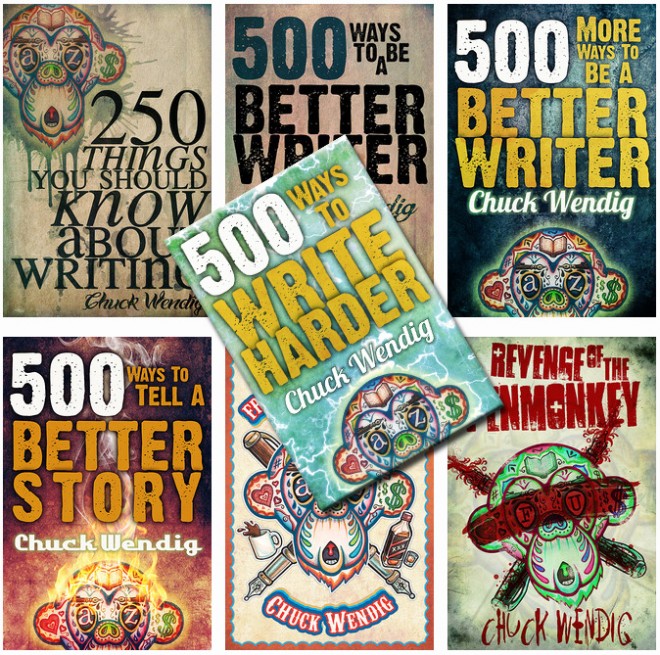
The Gonzo Big Writing Book Bundle.

*pay what you want, starting @ $10*

*offers ends May 31st*

Recommend A Book (And It Can’t Be Yours, Damnit)

It is that time again.

Recommend to me — us, because a whole lot of folks are reading this blog — a book.

It can be a book that’s been out.

Or a book that’s coming out soon.

Any genre. Any variant of publishing.

Tell us what it is, who it’s by, and why you recommend it.

Just. One. Book.

Not yours.

Not ten books.

A book.

Now, before I dart off, I’ll make a recommendation to you.

THE THREE, by Sarah Lotz.

“Lotz is a ferociously imaginative storyteller whose twisty plots will kick the stairs out from under you. She’s a talent to watch.”—Lauren Beukes, author of The Shining Girls

The Three is really wonderful, a mix of Michael Crichton and Shirley Jackson. Hard to put down and vastly entertaining.”—Stephen King

Four plane crashes happen simultaneously around the world. Appearing to have different causes entirely. And yet, in three of those accidents — and maybe, just maybe in the fourth, too — one child survived the devastation. I really don’t want to give away too much more than that, but from there unfolds one of the finest, freakiest horror novels put to paper. It’s told as artifacts — documents compiled and found — and offers a world real enough (and fragile enough) to feel like our own. That’s in fact what makes this book so terrifying, to me: the fact that you can read it and despite hints of the supernatural, it feels like oh, shit, if this happened, this is how it would unfold. All of life, a big-ass Jenga tower waiting to come down.

See, for me, the best horror isn’t just about the scares. It isn’t really about the horror.

It’s about the dread that follows in its wake. And this has that ten times over.

It also has one of the more harrowing descriptions of a plane crash.

Which I read while sitting on a plane, soooooo. Oops.

(And come to think of it, I hop on a plane tonight, too. MAYBE I’LL RE-READ IT.)

My only small issue with the book — and it’s a non-issue, mostly, in that it remains effective, if jarring — is the shift for the last part of the book away from the artifacts and into straight prose. The prose there is excellent and does the job it needs to do, but after over 3/4 of the book being told in one fashion, the hard shift is keenly felt.

Either way.

Go.

Get it.

This will be a huge bestseller, I predict.

Amazon | B&N | Indiebound 

Flash Fiction Challenge: The Stock Photo What-The-Palooza

Last week’s challenge: Must Contain This Sentence.

At Buzzfeed (yeah, I know):

50 Completely Unexplainable Stock Photos No One Will Ever Use.

Except, we’re gonna use ’em.

CHALLENGE ACCEPTED.

You’re going to pick one of these photos.

And you’re going to write 1000 words of flash fiction using that photo as inspiration.

Tell us which photo (by number) you’re using when you link to your story below.

Due by May 30th, Friday, noon EST.

Go forth and get weird.

Ari Marmell: Five Things I Learned Writing Hot Lead, Cold Iron

1932, and it’s business as usual in the Windy City. Yeah, the economy’s so low it’s looking up at Hell; Capone’s gone up the river; and anyone who knows anything says Prohibition ain’t long for this world. And still the Mob’s big and bad as ever, still got their fingers in every last one of Chicago’s nooks and crannies. You wanna get by in this city? You keep your head down and your trap shut, and you don’t make waves.

Especially when you got the kinda secrets I do.

So yeah, I give the trouble boys a wide berth. I sure as hell don’t ever work for them!

Except when I do. Except when some made guy’s moll tells me her daughter’s been missing for sixteen years, and they’ve been raising a good old-fashioned changeling in her place. Then, my better instincts aside, I start getting interested.

Me? I’m a P.I. Of course I am. Ain’t all these stories about a P.I? But I’m not your typical P.I.

The name’s Mick Oberon, or at least it is now. Yeah, like in that Oberon; third cousin on my mother’s side. I’m here in Chicago mostly because I’m in exile from the Seelie Court.

And like most of you have probably already figured, I’m not human.

* * *

1. As much as I hated homework back in school, I’m an anal-retentive OCD goober when it comes to real-world research for my novels.

I mean, seriously, I looked up the precise date of the spring equinox and phases of the moon in March of 1932 to make sure I got them right. I could have just made it up, and you know what difference it would have made? Zero. Zero difference. Hell, I ended up shifting the date a little anyway, because reality actually wound up being TOO convenient; it wasn’t believable.

That’s not a particularly difficult example–it was easy stuff to look up–but it’s the kind of detail-chasing that can suck you right down the rabbit hole. And when you’re in the rabbit hole, you’re not writing. Notice that there are absolutely no modern novels written by rabbits? THAT’S WHY.

A while back, I was answering some writing advice questions for a blog post, and I said something that got me yelled at. I said that it’s possible to do TOO MUCH research when writing a novel. A number of folks took issue with that, but I stand by it. There comes a point where your quest to unearth every little detail or get every little factoid just so is getting in the way of ACTUALLY WRITING. It doesn’t matter how much you’ve learned for your book if there’s no book taking shape.

2. Sometimes it is impossible to satisfy the aforementioned goober-portion of my personality.

The technology that causes elevator doors and train doors to open back up if there’s something caught in them? That existed in 1932. Had it already been installed on the L, in Chicago, though? Do you know? I don’t know. Nowhere I searched knew. The bloody Chicago Transit Authority didn’t know. (Yes, I contacted them. See: above, re: anal-retentive.) At that point, I figured it was safe for me to make up my own answer, and it STILL bugged me a little.

Through which process I also learned that my brain is an irritating little bastard who is quite happy to keep me from writing while it throws a little tantrum screaming “BUT WHAT IF I GET IT WRONG?!?!?!?!”

Stupid brain.

3. Slang is a motherfucker when you actually have to think about it.

No, really. Every slang expression in the book is genuine, and I had to deliberately decide where to place them and when to use them. You try going through a day where you have to fully think through even a one-word response! You’ll sound so off the cob, every mug you bump gums with is gonna think you’re lit on cheap giggle juice.

On the other hand, it would all have been worth it just to learn the phrase “Chicago typewriter.” You know what a Chicago typewriter is? It’s a Tommy gun. I LOVE that.

Gangland slang is WAY cooler than modern slang.

4. Speaking of slang, the Star Trek episode “A Piece of the Action” got it surprisingly accurate.

Well, maybe not so surprising, since a good portion of the crew probably grew up in the 20s and 30s. But yeah, the slang and expressions are pretty true to life. (And no, I’m not going to explain. If you don’t know what I’m talking about, don’t worry about it.)

(Heathen.)

It’s funny, we tend to think of some of those speech patterns only in terms of camp these days. Deliberately over-the-top. But it really was quite genuine at the time.

5. Welsh and Gaelic evolved so humanity could commune with the Great Old Ones.

Seriously, I refuse to believe those languages were developed with human jaws and tongues in mind.

Or the other theory, that Wales and Hawaii traded letters and sounds back in the day. One got almost all the vowels, the other almost all the consonants.

Which I guess would qualify as either a vowel movement, or consonantal drift.

Before I get the bum’s rush for that, I think I’ll show myself out.

* * *

Ari Marmell would love to tell you all about the various esoteric jobs he held and the wacky adventures he had on the way to becoming an author, since that’s what other authors seem to do in these sections. Unfortunately, he doesn’t actually have any, as the most exciting thing about his professional life, besides his novel writing, is the work he’s done for Dungeons & Dragons and other role-playing games. His published fiction consists of both fully original works and licensed/tie-in properties—including Darksiders and Magic: the Gathering—for publishers such as Del Rey, Pyr Books, Titan Books, and Wizards of the Coast.

Ari currently lives in an apartment that’s almost as cluttered as his subconscious, which he shares (the apartment, not the subconscious, though sometimes it seems like it) with George—his wife—and a cat who really, really thinks it’s dinner time. You can find Ari online at  and on Twitter @mouseferatu.

Ari Marmell: Twitter | Website

Hot Lead, Cold Iron: Amazon | B&N | Indiebound

Michael J. Martinez: Five Things I Learned Writing The Enceladus Crisis

Two dimensions collided on the rust-red deserts of Mars—and are destined to become entangled once more in this sequel to the critically acclaimed The Daedalus Incident.

* * *

The cool thing about writing is that it’s an ever-ongoing learning process. To paraphrase a certain pointy-eared son-of-a-bitch, writing really is infinite diversity in infinite combination. Each piece of writing is unique, and can be learned from – even if it’s learning what not to do. (Thankfully, I don’t think that’s the case with The Enceladus Crisis.)

I’ve been a professional journalist and communications writer for 20 years, and while I learned a lot writing my first novel, The Daedalus Incident, I was surprised at how much I learned writing the second in the series, The Enceladus Crisis, which came out just last week.  New books are cool.

So here’s what I learned this time out. A lot of it had to do with the challenges of writing a sequel, such as:

Nothing remains the same.

In a sequel, it might be a bit tempting to get the gang back together and go haring off on a new adventure and just play it like the last one, but with more knowing winks, wittier banter and bigger explosions. That only works in Michael Bay films. The first book didn’t happen in a vacuum. My characters aren’t the same, and neither is the setting. And only Dan Brown gets to recycle plot structures from book to book. I felt I had a better story when I changed it up, threw curve balls, broke up the band, blew it all to hell, swung for the fences. Insert change-related metaphor here.

Recapping is hard and needs to be done creatively.

As much as I wanted to go balls-out and write the story, I knew I’d have to do some recapping of what happened in the first book. That’s hard, man, because done wrong, it could drag the story down in a wave of boring exposition. In The Enceladus Crisis, I introduced the setting, and its changes, in the course of the story. And I dribbled out the exposition as sparingly as I could to keep the story going, while cluing in new readers. Still, there was a point when I had to explain what the “Daedalus incident” really was, in-story. So I used a military briefing as a framework, which helped introduce new characters in the process. I think it worked out well, but really, you have to take every chance you get to spread that stuff around.

Make the world bigger.

You know how your parents used to take you to the same vacation spot every year? And when you were little it was super exciting, but by the time you were 10, you were all like, “God, no, not Aunt Teresa’s lake house. It smells like old-man socks and she pinches my cheeks so hard it’s like pliers. Make it stop.” It’s fun to check in on places from earlier works, just to see how things are going. Some places can be particularly key to revisit over and over again. But there were others I just didn’t visit, because I had new places to go that were key to furthering the plot. It’s a balancing act, of course. You want to give folks a sense that the worlds are bigger than the first and the second books combined, but still, nobody cares if Venusian ur’chak tea serves as a particularly vicious, fast-acting laxative.

Make the stakes higher.

This is a double-edged sword, because strictly speaking, the assumption might be that you have to go from saving the city to saving the nation, to the world, to the solar system, and pretty soon you’re just this guy trying to save the multiverse and wondering why it’s all up to you all the damn time.

But stakes aren’t about “bigger,” per se, but rather “higher,” and that’s doesn’t mean throwing an asteroid at the problem. In The Enceladus Crisis, it meant hitting characters where it hurts most and making them – and the reader – fully invested in the story because, if they fail, it’s a crushing personal loss and/or they die horribly. Stakes have emotional resonance. One man could mean more to your heroine than an entire world, and if she has to save a world to save him, she will. Or maybe she has to destroy the world to save him, which is a tough call. Of course, you’re reading advice from a writer who crashed a sailing ship into Mars in his first book. And yes, I’d like to think I topped that spectacle in the second. But even as I blew more things up, I made sure to raise those personal stakes even more. I started feeling really bad for one character in particular, and that’s when I knew I was onto something.

Vacations are awesome for writing. So is air travel.

Obviously, this isn’t about sequelizing. And you’re probably like, yeah, no kidding, Sherlock. But you should understand that, after so many years of deadline journalism, I take great pride in writing anywhere, any hour and for as little or as long as I have available. Give me an hour, I’ll give you 1,000 words. Give me 15 minutes, and I’ll at least knock out that little knot in the story that was bugging me.

But this past summer, my wife and I took our daughter to her first sleep-away camp, and then took several days to just spend together in the mountains, sans kid. We’re both writers, and our vacation in the sticks became a writing retreat. We’d write in the morning or afternoon, for several uninterrupted hours, then go do other stuff. And I swear, I cleared a good 20 percent of The Enceladus Crisis on that trip.

So whenever you read that advice about writing every day – well, yeah. Do it. Ass-in-chair for as long as you can manage, daily. But if you can set aside some time to write, uninterrupted…take it and run with it and cherish it. The daily is good, but the “writing retreat,” if you will, really does work too.

* * *

Michael Martinez is the author of “The Daedalus Incident,” the first installment in the Daedalus trilogy. A journalist and professional writer by trade, Martinez lives with his wife and daughter in northern New Jersey

Michael J. Martinez: Website | Twitter

The Enceladus Crisis: Amazon | B&N | Indiebound