Chuck Wendig: Terribleminds

Apple-Obsessed Author Fella

Archives (page 229 of 481)

Revenge of the Awkward Author Photos: The Results!

Holy crapnoodles.

Nearly 500 votes later, I have tallied the results of the most recent Awkward Author Photo contest (the photos here!) — and hot damn, it was a nailbiter. For a long time it was a race between 11, 17, 38 and 61 — and then out of nowhere, little 72 started unearthed a secret vault featuring dozens of votes right at the end.

As such, that makes 72 our grand winner:

And it officially makes #61 our second place winner:

And third prize goes to #38:

I actually really love #38 and #71 — and of the ones that made me laugh the hardest, I’ll call special attention to #17, #28, and #59.

ANYWHO, so, you three winners — 72, 61, 38?

Email me! terribleminds at gmail dot com.

You got mugs and books and #72 has ONE FICTIONAL DEATH COMIN’ RIGHT UP.

And congratulations and thanks for playing, folks.

The Harvest: Out Now

“This strong first installment rises above the usual dystopian fare thanks to Wendig’s knack for disturbing imagery and scorching prose.” —Publishers Weekly

“Wendig brilliantly tackles the big stuff—class, economics, identity, love, and social change—in a fast-paced tale that never once loses its grip on pure storytelling excitement. Well-played, Wendig. Well-played.” —Libba Bray, author of the Gemma Doyle Trilogy, Going Bovine, and The Diviners

“A tense dystopian tale made more strange and terrifying by its present-day implications.” —Booklist

Under the Empyrean Sky is like a super-charged, genetically modified hybrid of The Grapes of Wrath and Star Wars. Wendig delivers a thrilling, fast-paced adventure set in a future agri-dystopia. Fascinating world building, engaging and deep characters, smooth, electric prose.” —John Hornor Jacobs, author of The Twelve-Fingered Boy

“A thoroughly imagined environmental nightmare with taut pacing and compelling characters that will leave readers eager for more.” —Kirkus Reviews

“A lunatic, gene-spliced, biofueled thriller. Fear the corn.” —Tom Pollock, author of The City’s Son

“An imaginative, page-turning adventure that will delight science fiction fans and have them impatiently waiting for the next installment.” —Joelle Charbonneau, author of The Testing Trilogy

IT IS COMPLETE.

The Heartland Trilogy is now a finished, published thing.

Because the third book, The Harvest, is out now:

Hardcover | Paperback | eBook | Audible | Audio CD

It’s exciting, because this is the first series I’ve truly finished — it’s the first one to make it out of the gate as a unified story told over several books.

Writing a trilogy or a whole series is tricky business — it’s a fine art between balancing the long con of far-flung planning but also course correcting between books and changing the story as you go. Some things about the Heartland series ended where I always expected, and some things didn’t. Some characters made it that I thought would perish — and *coughs into hand* some who I thought would survive didn’t cross the finish line with the rest of us.

There’s all kinds of things going on in this series — it’s a series about power, nature, and youth. About class warfare and oligarchy. About the struggle to do something real and change the world when you don’t want to. It’s a series about growing up in a world of oppression and war. And in a way, a series about growing up poor.

(You can actually find out a little about the origins of the series in this “Big Idea” post over at Scalzi’s WHATEVER joint, where I unpack how this cornpunk series came to mind and why I wanted to write it so bad.)

But it’s also got bloodthirsty corn, love triangles rhombuses, people turning into plants, hoboes, floating cities, arranged marriages, talking birds, multiple Pegasuses, robots, skyboats, piss-blizzards (sorry, “pollen drift”), tornadoes, a fallen city, a serial killer, and more. It’s young adult, though obviously I hope it appeals to adults, too.

I also posit that if you’re looking to see how well I’ll handle writing Star Wars: Aftermath, then this might be the series you’d wanna check out.

In fact, you can now buy the whole trilogy in e-Book for less than $12:

Under the Empyrean Sky: e-Book.

Blightborn: e-Book.

The books are eligible for Amazon Matchbook. Which is to say, if you buy the print book, you are eligible for a deep discount ($0.99, I think) on the e-Book.

Anyway, hope you check it out and spread the word.

Next up: Zeroes.

After that: Aftermath.

P.S. Tonight I’m doing the launch event at 6:00PM at Let’s Play Books in Emmaus, PA. Stop by, say hi. Or, if you’d like to bounce them a message and ask about obtaining a signed book, please do — I believe they can furnish that request. Call them at 610-928-8600 or go to: www.letsplaybooks.com.

P.P.S. Bonus: no racist old Atticus Finch in this book!

News And Observations From SDCC

*leaps off the back of a wyvern, lands in front of you in a crouch, ignites lightsaber, accidentally chops off part of own beard with it, howls in rage*

AND WE RESUME BROADCAST.

Hi, everyone! How are you? Did you enjoy your week away from TURRIBLEMIMES?

*checks notes*

Sorry, I mean, “terribleminds?”

Whatever.

Point is, I have returned from the HUMAN POP CULTURE THICKET that is SDCC (aka San Diego Comiccon), and I have been changed. I have been shaped — transmogrified! — by it. It was my first such event, and, yoinks.  As such, I thought I’d pop the latch on the ol’ blog and revisit with a news and observations post.

Let us begin with

Some News And Such

• I was fortunate enough to get my own small bit of news in and then out of SDCC. Remember that Star Wars book I’m writing? A silly little thing called Star Wars: Aftermath? Well, Aftermath is now a proper trilogy. And I’m the one writing it. (News here at Entertainment Weekly!)

• I got to do a rather big geeky publishing panel — a Sci-Fi versus Fantasy Family Feud game. I was on the side of Sci-Fi with the likes of Ernie Cline, Daniel H. Wilson, and Austin Grossman. We were opposed by the raucously popular FANTASY KIDS: Leigh Bardugo, Brandon Sanderson, Naomi Novik, and the Eldritch Yggdrasil Beard himself, Pat Rothfuss. Fantasy was super-popular with the crowd, and it occurs to me that the FANTASY KIDS could easily become a violent street gang that could itself become a cult. They are dangerous, and they need to be stopped. *hangs up posters around town warning you about the FANTASY MENACE* More seriously, the Sci-Fi team totally lost, but I call shenanigans on the survey questions, damnit. One of the most popular cult films by survey was — wait for it — Star Wars. Which I think is the definition of the opposite of a cult film? Whatever. It was a blast, we had a hoot, the audience seemed to love it, and we got to explain to Daniel H. Wilson what a horcrux was.

• Speaking of that Family Feud game, we did a signing afterward and someone let me hop into this photograph and diminish it with my presence:


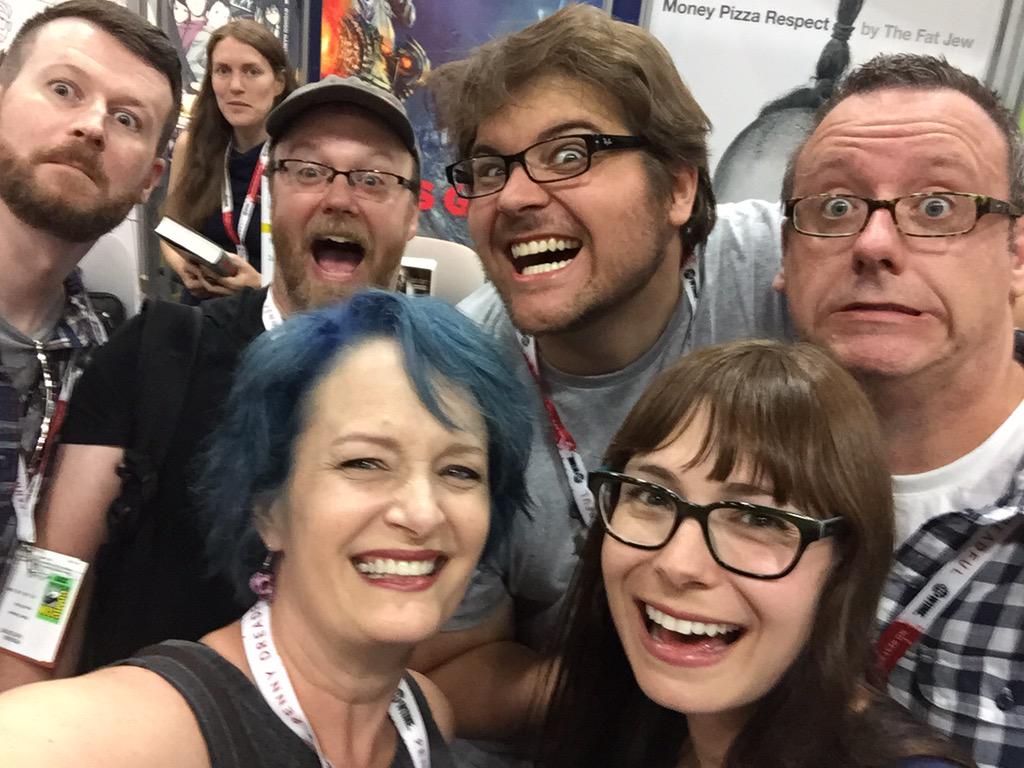
• Sweet hot hell, I got to meet Gary Whitta and Veronica Belmont at one time. Gary Whitta is of course the Force-wielding ubermensch writer behind Star Wars: Rogue One and also he’s working on Rebels now and oh let us not forget about this amazing new novel of his, the blood-soaked historical fantasy, Abomination. Veronica Belmont is one of the bad-asses behind Sword & Laser and is also ready to deliver unto you ethical and emotional tech advice with her new video column at Engadget, Dear Veronica. Now look at this cool picture of cool people! Robert Brockway looks like he’s scanning your brain. I’m travel-encrusted and high on exhaustion! Sam Sykes is gonna eatcha! Gary Whitta may have fouled his pants! Veronica is happy because she’s facing away from the rest of us! Diana Rowland is aware of the hilarity of her situation!

• I should also mention that Brockway’s The Unnoticeables came out this week, and it’s really fucking good you guys. I don’t even know what to call it. Just click.

• I signed a bunch of Star Wars: Aftermath posters.

• I signed all the present copies of ZERØES which was cool — I had a line of people!

• I apparently also got food poisoning? Or some kind of stomach bug. We always say it’s food poisoning and then we play the game of where we got it from, and I did eat sushi that night but I ate it from a reputable restaurant but it also wasn’t that great but you also have to eat it with your hands and for all I know I had somebody’s FOUL GERMSLURRY under my fingernails when I was popping tuna nigiri into my snapping maw and that’s what did it? I dunno. All I know is, already exhausted, I got about three hours of sleep peppered between me rolling out of bed and, ahem, having to attend to the goblins trying to get out of my intestines. IT WAS SUPER-GREAT YOU GUYS. The next night I missed a dinner meeting because I literally collapsed on my bed and fell asleep for over four hours, sleeping through my iPhone alarm, phone calls, and a rock concert playing loudly outside. I maybe died for a while? So that’s cool.

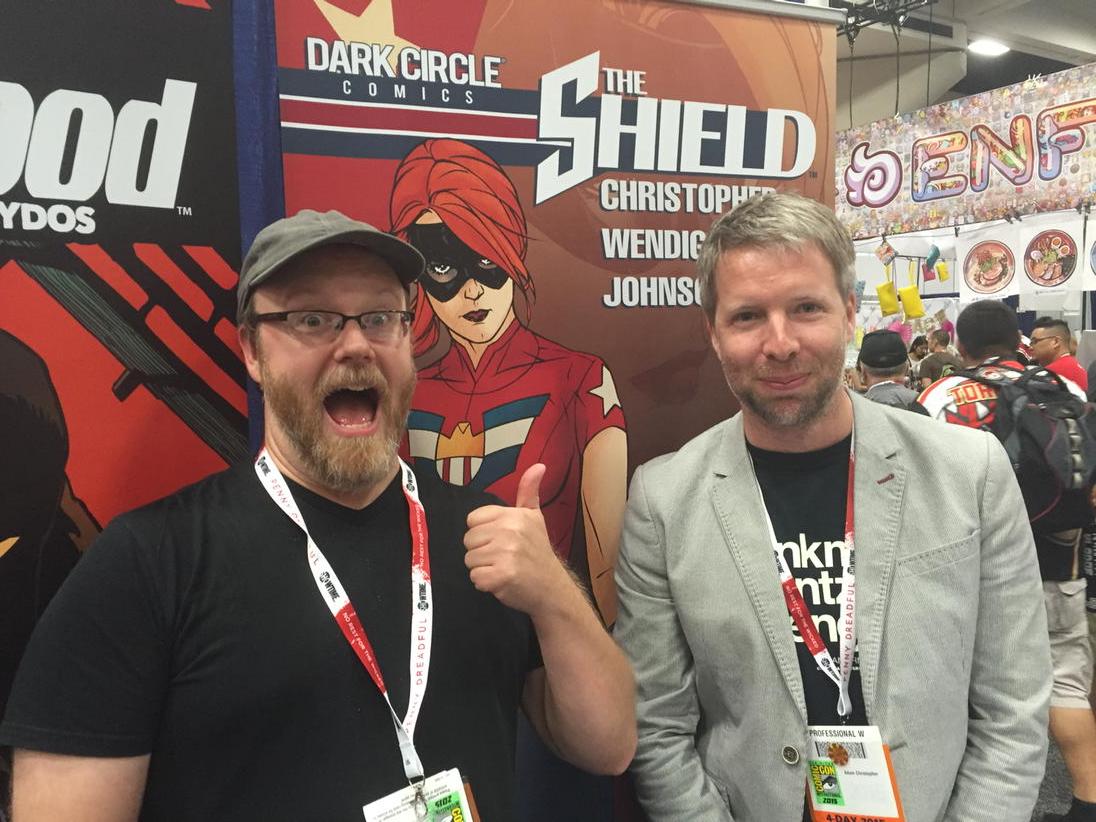
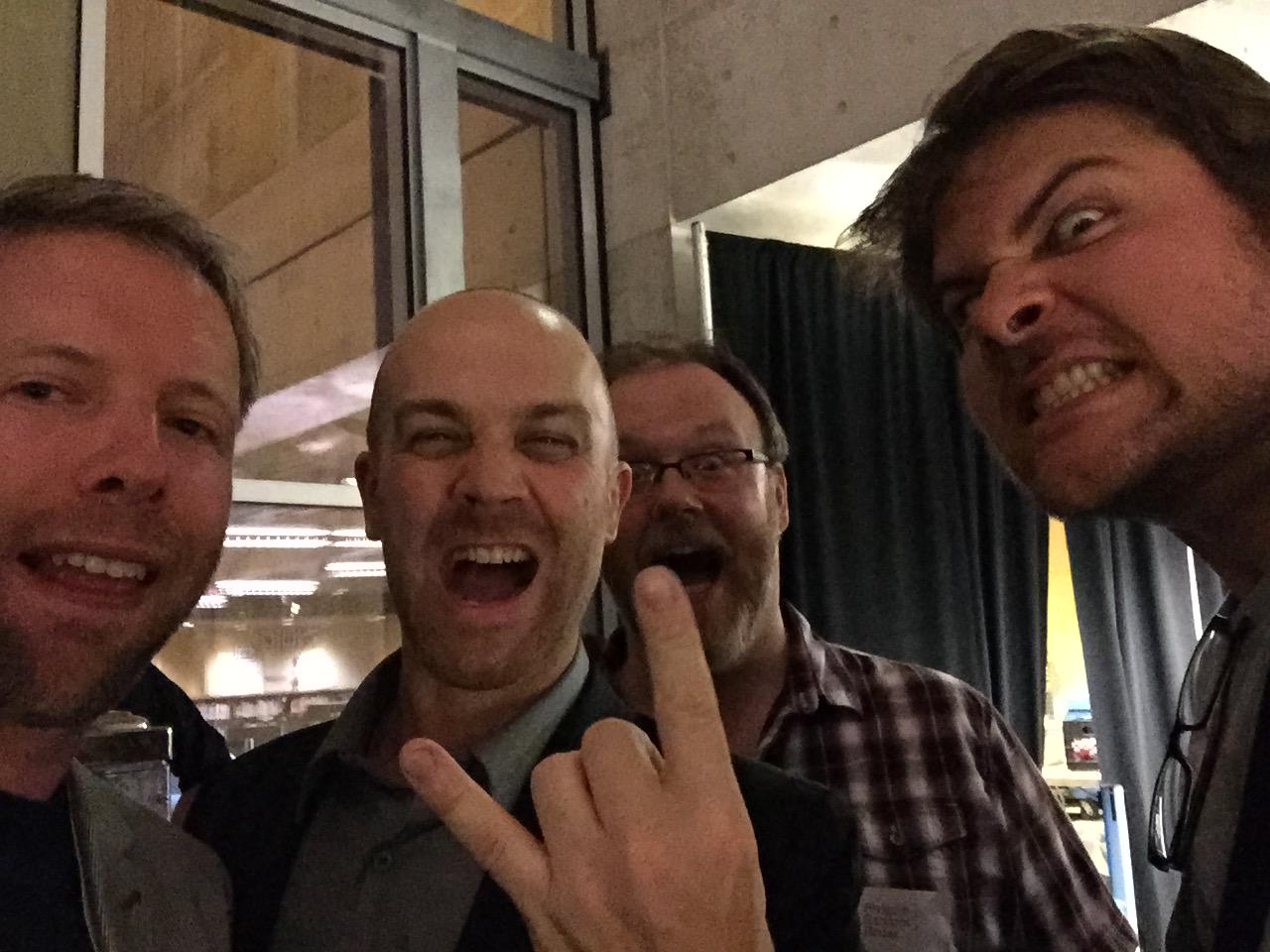
• It is rare I get to actually hang out with my Shield co-writer Adam Christopher, because he lives in — *checks a map* — East Umbria or New Zorbland or one of those other Non-American countries? They blur together. Either way, we got to hang multiple times, including once at a really weird party I cannot tell you about. Look! Here we are! GAZE UPON US AND DESPAIR. I’m loud and foolish! He’s reserved and cheeky! I’m American! He’s North Zorblander! We fight crime.


• I got to hang out with Rhianna Pratchett. Which is basically, you know — *scratches one off the ol’ bucket list* — because she’s amazing. Games! Comics! Wonderful human being!

• At the signing post-Family Feud, me and Leigh Bardugo sat next to each other which I think is the equivalent of sitting the two chatty clowns at the back of the classroom. She was the bestest sign-line buddy you could ever have. Here is a photo of us judging you for your transgressions.

• Actually, I got to meet and or hang with an unholy host of people that cannot and will not be properly enumerated here, but I’ll give a sampling: Paul Cornell, Kelly Sue DeConnick, Pierce Brown, Robert Venditti, Diana Gill, Peter Clines, Zen Cho, Joe Monti, Daniel Kraus, Hugh Howey, Alex Segura, the Star Wars publishing team (including the mighty Holocron Keeper himself), Scott Sigler, Wes Chu, Ty Franck, Daniel Abraham, Richard Kadrey, Beth Cato, David Pomerico, Jim Zub, and *cough cough* other people! I have a brain like a sieve!

So, Onto The More Observationscented Portion…

• SDCC is a human zoo. You need to know that going in.

• What this means is, if you’re like most writers (which is to say: an introvert faking extroversion, a failed actor afraid of the stage), then you will probably find those crowds challenging at some point. I loved it until I didn’t. One moment it was like, Yeah, this rules, all this geeky goodness and the pop culture awesome and then a switch flips and it’s like I MUST GET OUT OF HERE and your brain feels like a squirrel trapped in a jar full of biting ants. The sheer throngs of humanity will challenge even the most well-heeled introversion.

• SDCC was, for me, very busy, very buzzy, and very businessy. What I mean is, it was a) non-stop, b) lots of little industry whispers and rumors and c) lots of meetings and business stuff. I came out of the con with a handful of new potential opportunities if I want ’em. Which means the show was ultimately a success. That plus meeting tons of fans and hopefully making new fans — that made it really worthwhile. Your mileage may of course vary.

• San Diego is easily one of the most beautiful cities. It’s July and it was like, low-70s during the day and sea-breezy. Gorgeous weather, lovely town.

• At San Diego, you will encounter smells. Because humanity ultimately smells. We’re basically just bears pooping on our own fur. Some of the miasmas you will wander through while walking the con floor: GARLIC SWEAT GUY; DUDE WHO SMELLS LIKE THE NACHOS HE IS CURRENTLY INGESTING AT AN UNHOLY CLIP; GUY WHO MAYBE KNOWS HE SMELLS BAD SO HE BATHES HIMSELF IN ACRID COLOGNE OR AXE BODY SPRAY AND NOW HE’S A BIOWEAPON; DEMON FART; A CLOUD OF SOMETHING SWEET AND SOMEWHAT SICKENING; HOT VAPORIZED BPA PLASTIC; PATCHOULI; POOP. All of these smells get worse by Saturday.

• Saturday is, obviously, the worst day to wander the floor. People clog the channels like cholesterol in an old man’s ever-tightening arteries.

• Publishing does not have an epic presence there. I mean, it does in terms of people — but in terms of actual floor space, it’s not particularly triumphant. You’ll find that NYCC has a much stronger literary presence (likely due to the NYC proximity).

• This might be because so much of SDCC is about spectacle — not to say it’s not at all about comics or books or any of that, but the show is built around BOOM and ZOOM and OMG and books do not necessarily demonstrate that kind of vigorous excitement well. You can get people excited about a new movie trailer; less so an advanced reader’s copy of a book. SDCC is all about the TV shows and movies and ye gods, the toys, the toys. It’s fantasy on display, practically weaponized. (Speaking of toys, thanks to Adam Christopher for nabbing me a First Order Stormtrooper figure!) A lot of the publishing stuff is behind the scenes and less up front. (At least, from my limited, one-year-exposure to the con.)

And Now, More Photos From Me And Other People!


S.K. Dunstall: Five Things I Learned Writing Linesman

In reality, this should be ‘five things we learned writing LINESMAN’, for there are two of us. Which naturally, leads to our first thing we learned….

Writing together is more fun than writing alone

Co-writing is not for everyone. In some ways it’s like being married. It works for some people, but for others that close, intense relationship with another person is too much.

First of all, we probably wouldn’t have gotten our agent we hadn’t been writing together, because after requesting a full manuscript, our then-not-yet agent came back and suggested we change one of the main secondary characters from male to female. One of us (Karen) was adamant that we weren’t going to change anything. “These characters are great just as we wrote them.” (Guess which one of us created that particular character. Newbie writers. They’re so precious about their stuff.)

Sherylyn persisted. That’s what co-writers do. Talk to each other and if something sounds reasonable, keep talking until the other one at least considers the idea objectively, without the emotional attachment.

As it turns out, it was the best thing we ever did with the book, and turned a stereotype into someone who is a great character in their own right.

But writing together has more benefits than just making sure the other writer be reasonable. You are each other’s harshest critics, and you’re honest with each other. At least, we are. It’s like having an alpha and a beta reader on tap every day.

It’s also faster to fix problems, because you talk them out. A lone writer might mull over a troublesome section for weeks, but two of you can talk it out over a single long evening’s discussion. You get back on track faster.

Best of all, you’re talking to someone who’s as passionate about the story as you are.

Enjoy the unagented time

We all want an agent, we all want to be published, but it’s only after you get one, or both, that you realise you have lost the freedom write any idea that pops into your head. At least temporarily.

Getting an agent is mind blowing, and getting a contract to publish just adds to that high. But once you’re agented (or have a publishing contract) you need to be a little more commercial about your work. You are working to timelines. You are working on what you have committed to produce.

You are also probably, initially at least, working solely in the genre your agent/publisher accepted you in. We write fantasy and science fiction, but we sold a science fiction. Our agent wants to develop us initially as writers of science fiction. We’re happy with that, because we love sci-fi, but you don’t realise how much freedom you have as an unagented/unpublished author.

Enjoy the freedom while you can.

Eventually, you have to come out as a writer

We kept our writing close to our chest for a long time. If people asked what we did in our spare time we’d mumble something and change the subject. Other people travelled, or had kids to take to sports or ran marathons. Us, we stayed at home and wrote novels.

Once you have a contract it’s a little easier to talk about your book, but not much.

When people at work ask what you did on the weekend, they’re not expecting you to say, “I stayed in to finish my novel.”

Then, once you have come out, you have to learn to be positive about your novel, not put it down.

“It’s just a space opera,” isn’t the right answer to someone who asks what you write. You need to start learning to say, “It’s a space opera. Do you know what space opera is?”

“No.”

“Think Star Wars. Or Guardians of the Galaxy. Only our book is about a guy who repairs spaceships and gets caught up the discovery of an alien ship and is trapped between two warring powers who both think that control of the ship can help them win a war.”

Don’t go on and on, but don’t put yourself or you book down either.

Cultural writing differences

There are more differences between countries than just spelling, or even changing a car boot to a trunk.

Our first copy edit came back with over five thousand changes. That’s right. Five thousand. Most of them were serial comma changes. i.e. putting a comma before the final ‘and’ in a list. We also never put a comma before the ‘too’ at the end of a sentence when we used too to mean ‘also’.

Here in Australia our standard is not to use serial commas (also known as Oxford commas) unless they are absolutely necessary. Our publisher, however, uses the Chicago Manual of Style, and guess what. Yep. Oxford commas everywhere.

(We learned some other things too, like we didn’t need all those ‘toos’. Unfortunately, we left a lot of them in because we didn’t know how many changes we could make at that stage of editing. You live and learn.)

Book two is better. We promise.

Newly published writers are narcissistic

We never considered ourselves vain, but we spend a lot of time searching our name on the intranet. From what we’ve read, you do grow out of it, but right now it’s still a huge buzz to search for ‘S K Dunstall Linesman’ and finding something new. Obsessively stalking GoodReads and Amazon to see if anyone has reviewed your book yet. The high you get when someone gives you a five-star review.

People say “Don’t read your reviews,” but seriously, it’s almost impossible when it’s your first book.

We’re sure we’ll get better, but right now, we’re enjoying the ride.

S K Dunstall: Website | Twitter

Linesman: Amazon | Barnes & Noble | IndieBound

Carrie Patel: Five Things I Learned Writing Cities and Thrones

Jakkeb Sato’s revolution transforms the city of Recoletta. He dethrones the old oligarchs, opens up the secret archives, and establishes a new government based on change and transparency.

Months later, Recoletta is in shambles, the farming communes have revolted, and neighboring cities scheme against the crippled behemoth.

Inspector Liesl Malone, now chief of police, must protect her city from black market barons, violent insurgents, and the excesses of Sato’s new government. Meanwhile, Jane Lin has fled to the city of Madina, where she learns of a plot to crush Recoletta. Jane must decide whether—and how—to save her old city from her new home.

***

SEQUELS ARE HARD

Writing is a lot like hiking through a snowstorm. You set your eyes on a distant summit and press forward despite pain, toil, and the fussing of your own better judgment. You tell yourself that, once you reach that shining peak, you will find a nice, warm hut with hot chocolate and a place to pee.

When you arrive, you find that you’ve still got a long ways to go and nothing but a windswept crag for relief.

After I finished writing my first book, I thought the second would be easy.

Oops.

It turns out that writing a sequel isn’t easier than writing a first novel. The challenges are just different. The first draft came out cleaner, and I was better able to dodge structural pitfalls without sinking thousands of words.

But even improvements can be mixed blessings. In some ways, I think my growth as a writer slowed my progress. I was more deliberate with my plotting because I was quicker to recognize the ideas and impulses that didn’t work. I was more cautious at the keyboard because I was choosier about the words I was typing. I would break the first rule of drafting—which is to keep the words flowing—when I caught myself writing convoluted or insipid prose.

And we haven’t even gotten to deadlines yet.

KEEP IT FUNKY, KEEP IT FRESH

Yet in some ways, writing a sequel can be relaxing. After all, you’ve already established the world and introduced the characters, so the groundwork is laid. Now you get to play with pieces you already know well.

But this can also be a danger, for familiarity often breeds complacency. You need to keep your second book as fresh and exciting as the first. If it’s not fun to write, it probably won’t be fun to read, either.

In other words, approach the second book as a new race, not as a victory lap.

Take risks with your characters. Push them, prod them, and discover something new about them. Flip the world over and see what’s crawling along the underside. If you can surprise yourself with new twists and developments, chances are good that you’ll surprise your readers, too.

BALANCE

You write your first book with whatever stolen hours you can cobble together from work, sleep, and playtime. You become a miser with your free moments, the Ghost of Shouldn’t-You-Be-Writing always hovering nearby. You write, sometimes because you want to and sometimes because you need to.

Writing the second book is still like that, but there’s a clock ticking in your ear.

And revisions to complete on your first novel.

And this ominous thing called an “online presence” to build.

I thought I would have a handle on this squishy work/life balance thing by book two, but alas, I did not figure all my shit out in the span of a year. In fact, I’m now chuckling at the notion that I actually expected this to happen.

In fact, maybe that’s the real lesson. Keep your expectations real and manageable. Give yourself one thing to do well every day, and enjoy the small successes. You probably won’t figure the rest of your life out by the time you’ve written your second book.

But if you do, maybe drop the rest of us a hint?

SO SHALL YE REAP

Some writers have every scene and detail of their nascent series plotted and diagrammed before the first book is sold. Others make most of it up as they go along, which can be both exhilarating and nerve-racking when we introduce that ticking clock we discussed a moment ago.

I wrote The Buried Life without definitive plans for a sequel, but when the opportunity to begin Cities and Thrones arose, I found that I was ready and the way ahead clearer than I would have thought.

Once again, it’s all about groundwork. If you’ve sown your field well in the first book and seeded it with plenty of juicy world building details, character motivations, and story arcs, then you should find yourself with plenty to work with when you return to that territory for the second book.

Some of the pieces you set in motion in your first book will find their targets in the second. They’ll proceed with satisfying symmetry, landing more or less where you’d hoped.

Others will surprise you. They’ll careen along unexpected trajectories, tumbling farther and faster than you’d imagined. Minor characters will fight for center stage. Brief asides will become central plot points. Be on the lookout for surprises like these because they’ll give your story real momentum if you know how to harness them.

TAKE IT TO ELEVEN

At the end of your first novel, you’ve pulled out all the stops, blown the amps, and gone for broke. You’ve held nothing back, yet you’ve got to find some kind of direction for your sequel.

The only direction, my friends, is up.

There’s always something new and big to show, and even if you ended your last book with some major seismic activity, just remember that the aftershocks can often be bigger and louder.

So trace the consequences of events in the first book and pick up the next crisis or question. Take your writerly perspective and zoom out to show how your last finale changed the world at large. Or pan it left and follow the ripples to a new epicenter that’s set to buckle. Or zoom in, nice and tight, and show us what happens to the characters when the rug’s been pulled out from under them.

There’s plenty of story to tell, even when you’ve already pushed everything to ten. You just have to find eleven.

***

Carrie Patel is an author, narrative designer, and expatriate Texan. When she isn’t scribbling her own fiction, she works as a narrative designer for Obsidian Entertainment, where she wrote for Pillars of Eternity. Her work has also appeared in Beneath Ceaseless Skies. Cities and Thrones is her second novel.

Carrie Patel: Website | Twitter

The Buried Life: Amazon | B&N | Indiebound | Goodreads

Eject

Hey, folks! Out of spoons over here, so I’m taking a vacation.

A social media vacation, at least.

I’m gone this week to SDCC and the next week to NECon and then having some friends visit? So, for the next week, the blog is going to sit quietly in the corner and think about what it’s done. I’ll be on Twitter and Facebook only scarcely, though I won’t be entirely absent. I will be back to the blog for the release of The Harvest, which drops next Tuesday. (Preorder here.) No flash fiction challenge this week or next, though you will find some FIVE THINGS I LEARNED promo posts popping in on their respective Thursdays.

I also remind you that the new edition of Blackbirds is still on sale: $1.99 for digital.

Finally, Relentless Reading did a quicky interview with me about stuff and things.

Go buy awesome books and read them and tell people about them.

That is all.

Be good.