Chuck Wendig: Terribleminds

Apple-Obsessed Author Fella

Archives (page 243 of 479)

Harry Connolly: The Loneliest Student (Writing as a Subject of Study)

Harry Connolly’s an awesome dude — I had the pleasure of including one of his stories in an anthology I edited, Don’t Read This Book, and he’s a real talent. Harry’s out there kicking ass with a series of new novels, and so I’m happy to host him and his thoughts here.

* * *

I’m coming to the end of a long (long) blog tour, and I’ve spent most of it talking about how we write, how we can improve our writing, and the way to analyze stories.

But terribleminds is already full of good writing advice, so I knew that I needed to dig a little deeper when Chuck offered to lend me his space.

Then I saw his pair of posts about talent. I’ve got my own rather unflattering view of talent as a concept, and I agree with Chuck that the best thing any writer can do, no matter where they are in their career, is to study writing as though there’s no such thing.

With that in mind, I want to talk a little bit about the way we study, and the best way to learn.

Recently, I came across a book called Make It Stick: the Science of Successful Learning, by Peter C. Brown, Henry L. Roediger III, and Mark A. McDaniel (hereafter “BRM”) which gathers up a crapton of recent test results in clinical psychology to lay out what the latest research says is the optimal way to study in order to master a subject.

I know, I know. There are always books like this, and if you’re in education you probably see them zoom by more often than 18-wheelers on an interstate. But, it’s a respectable press and the reviews were solid, so I gave it a try.

And not just for myself. In addition to being a writer, I’m also a homeschooling parent. So, not only have I been trying to adapt the lessons in this book for a lazy, immature student who resents the time that study takes away from computer games, I’ve had to do it for my teenage son, too.

The book is geared toward people in college or beyond who are studying complex academic or vocational subjects; it doesn’t specifically address learning the arts. That complicates things, because writing is full of good/bad/better choices rather than right or wrong answers. Still, I found much that was applicable.

First we should look at Bloom’s (revised) taxonomy of learning, which you can see here on Wikipedia. The most basic layer at the bottom is simply knowing something. Above that, understanding it, then being able to apply it in new situations. The level above that is split in three: Analyze, Evaluate, Create.

So, for instance, if you were to ask me how Seattle can have such mild weather when we’re at the same latitude as the northern part of Maine, I’d tell you that it’s because of our “Oceanic” climate and mountain ranges. Boom, I’m at the lowest layer of Bloom’s taxonomy for that question, but sadly I can’t go higher to actually explain it. I know it has something to do with the jet stream and the Cascades, but the actual mechanics slipped my mind long ago.

The reason why I’ve forgotten is where we hit the first technique that BRM recommend: self-testing. In fact, according to the studies they’ve looked at, high stakes testing designed to measure how much students have learned is not an effective way to teach, but low-stakes testing where students are asked to recall what they’ve learned is an excellent way to reinforce that learning. “Testing interrupts forgetting” is their conclusion.

And it’s not just pop quizzes from teachers, either. Self-quizzing is the basis of study and learning. Trying to find the perfect word for the end of a sentence? Research suggests that making an effort to recall it before looking it up in the dictionary (rather than looking it up immediately) will make the word stick in the memory better.

Research also suggests that lessons that do not require much effort leads to forgetting them quickly. Reading text in a difficult font or that’s slightly blurry leads to better reading comprehension than text in a clear, comfortable font. Being forced to make that effort feels like an impediment to learning because the student experiences it as uncertainty, but studies have shown that, however it may feel at the time, it’s the best way to retain knowledge in the long term.

To apply it to writing, I have stopped being so quick to grab the thesaurus when I know the word I’m about to type is the wrong one. I use it when I have to, but first I spend a minute trying to come up with the right word on my own. Yeah, it slows me down in the short term, but I expect to need it less as time goes on.

Also, when I’m reading, I stop every couple of chapters to review (like study guide questions in school textbooks). What’s happening with the plot? What thematic elements are emerging? What stakes are the characters facing? What tricks is the author using to speed or slow the pace? And so on. If I feel the need to look back at the text to check the way the paragraphs are structured, or to see if there’s a recurring color or image motif, I’ll test my memory first.

The next principle to good study is spacing out practice and what’s called “interleaving.” Basically, to really learn something well, it’s best to self-quiz with a delay between study sessions, so that we can call up and reinforce the knowledge we need to acquire. Also, it’s best to mix up the topic of study.

Therefore, instead of doing several problems on fractions, then several on decimals, then several on negative numbers, it’s best to switch between them. Again, this will feel as though the student is less sure of their knowledge, but mixing the study of math problems (or techniques of famous painters or basketball drills, or…) has proven to be the best way to retain the information, because it lets students compare and contrast problems and their solutions.

This one is harder to apply to writing. I write pretty much every day, and mixing up different sorts of scenes is perfectly natural. One day I’ll be writing a fight scene, the next a mellow scene between friends, the next a tense planning session. Variety is the spice of fiction, and it’s sort of built in.

Except when it isn’t, obviously. If I’m writing 20,000 words of action adventure to wrap up a book, I’m certainly not going to stop every other day to work on a contemplative or funny short story. I’m going to tear through to the ending with as much momentum as I can muster.

However, I am going to apply this principle to my reading. For example, if I want to study up on private investigator novels, I’m not going to tear through a stack of five of them any more. I’m going to mix them up with a police procedural, a heist novel, a romantic thriller, that sort of thing. According to this theory, I’ll learn more about PI novels by comparing and contrasting them with other subgenres than I will by studying them alone.

The final study principle that I’m going to discuss here is what the BRM calls “Generation.” Basically, it involves restating a new piece of knowledge in your own words, or tying it to previous learning, or tying it to your personal life in some way.

I use this trick every time I talk to my wife about a story problem I’m having. Just describing it to her usually makes me realize what the answer should be. Another way to use Generation comes with one of the questions I ask myself when I’m reviewing a book I’m reading: “What do I think should happen next? Where would I take the plot from here?”

Closely related to Generation and self-quizzing is what BRM call “Reflection.” When using Reflection, the student mentally reviews what they’ve learned and assesses how well they know the material. They also try to apply what they know to problems they might foresee.

This is something I do all the time. Before I wrote Child of Fire, I spent several weeks thinking about the best ways to combine crime thrillers with magic. It wasn’t necessarily fun work, but it was invaluable to the success of that novel. Lately I’ve been thinking about those cinematic action heroes that never speak and rarely change their expression. Personally, I find that sort of thing compelling as hell, so sometimes I spend an hour or so (usually during a long walk) trying to figure out how I’d make that work in text without using cinematic POV.

What I’m offering here aren’t tips for better writing; I doubt I could provide better than what Chuck regularly posts. I’m writing about study methods that will help create mastery more efficiently. That’s my goal.

Ob sales note: in the fall of 2013, I ran a Kickstarter for my new trilogy. It was successful.

That series, part apocalyptic thriller, part epic fantasy, was delivered to backers and is now available for sale. Book one received a starred review from Publishers Weekly and a favorable review on Boingboing. Check out the cover:

The Way Into Chaos Cover

You can find out more about that first book here, or you can read the sample chapters I’ve posted on my blog.

More recently, I’ve released the last of the stretch goal books from that campaign: a pacifist urban fantasy called A Key, an Egg, an Unfortunate Remark, which features a 65-year-old socialite protagonist who is equal parts Auntie Mame and Gandalf. You can read more about that book, or go straight to the sample chapters.

Thank you.

* * *

Harry Connolly’s debut novel, Child Of Fire, was named to Publishers Weekly’s Best 100 Novels of 2009. For his epic fantasy series The Great Way, he turned to Kickstarter; at the time this was written, it’s the ninth-most-funded Fiction campaign ever. Book one of The Great Way, The Way Into Chaos was published in December, 2014. Book two, The Way Into Magic, was published in January, 2015. The third and final book, The Way Into Darkness, was released on February 3rd, 2015. Harry lives in Seattle with his beloved wife, beloved son, and beloved library system. You can find him online at www.harryjconnolly.com or on Twitter as @byharryconnolly

Cover Reveal: The Harvest (Heartland, Book Three)

HEY, LOOK AT THAT.

It’s the brand new cover to The Harvest, the third (and final) Heartland novel.

I again have won the cover lottery thanks to my publisher, and the artist, Shane Rebenschied.

The book comes out July 14th.

It pulls no punches and… *whistles*

Well, you’ll see.

Here’s the official description (which, admittedly, is a hair spoilery).

Blood will water the corn…

It’s been a year since the Saranyu flotilla fell from the sky, and life in the Heartland has changed. Gone are the Obligations and the Harvest Home festivals. In their place is a spate of dead towns, the former inhabitants forced into mechanical bodies to serve the Empyrean — and crush the Heartland.

When Cael awakens from a Blightborn sleep, miles away from the world he remembers, he sets out across the Heartland to gather his friends for one last mission. As the mechanicals, a war flotilla, and a pack of feral Empyrean girls begin to close in on the Heartland, there isn’t much time to make their next move. But if they can uncover a secret weapon in time, Cael and his friends might just find themselves with the power to save the world — or destroy it — resting in their hands.

You can pre-order the book here.

You can read the first book, Under the Empyrean Sky.

Or the second in the series: Blightborn.

Or you can read the short that prequelizes the series: The Wind Has Teeth Tonight.

(And given the Star Wars news yesterday, a lot of folks who aren’t presently readers of mine are wondering if I’ve written anything close to that, and I’d say: check out the Heartland series. DO IT. DO IT NOW. *throws a wampa at you*)

The Flipside Of My Writing Tirade

I Storified a bunch of tweets yesterday where I did my boot-stompy grr-arrgh finger-wagging bear-posture and growled at you for not writing and for giving into your excuses.

And today I read a good response to that, which you can read here.

(That response by someone called “Pipsqueak the Ferocious,” which is awesome.)

I will quote the latter portion of this person’s post, though you should certainly go and read the rest of it (and spread it around the Tumblrs if you so choose), but I’ll quote one vital bit here:

Chuck’s tirade is good for me right now, but that’s because my brain is functioning well at the moment. If I’m not working when I’m supposed to, it’s because I’m lazy and/or avoiding responsibility. But you know what? I’m not not working right now. I can focus on my work. I can laugh off those shitty lines I have to write and fix later just to get to the next thing that happens. I’m in fact less inclined to refer to anything I write as shitty in the first place.

I can take Chuck’s tirade right now because I’m capable of healthy perspective.

If you do not currently have the same capability, please keep in mind that you can’t run on a bum knee.

Not writing when your brain is hurting doesn’t mean you’re worthless. It doesn’t mean you’re bad at what you do. It doesn’t mean you’ll never get better. And it doesn’t mean you don’t deserve to try again when you feel better.

And when you do feel better, show the fuck up. Work your ass off. Get your words on the page. Show that goddamn depression—or whatever your hurdle is—who the fuck is in charge of what you’re capable of accomplishing.

Assume that the quote above pretty much covers it.

And also assume that anything I say after this is probably best ignored, because, no, really, Pipsqueak the Ferocious said it best. That said, I’m someone who doesn’t always know when to quit talking, so let me unpack this a little bit.

I ranted yesterday, and today I want to counter with the flipside of that, a little bit. I want to stand before you and say, TELL ME WHAT THE BAD MAN SAID TO YOU, and you respond with, YOU’RE THE BAD MAN, IT WAS YOU, WEIRDO, and I will just say in response SHHH SHHH SHHHH, HERE’S A BALM TO SALVE THE STING and you’re all like DUDE THAT’S JUST COCONUT OIL and I’m like SHUT UP IT’S A SUPERFOOD.

Some of the response to my little ranty-blather veered between cheerleading — yay woo you’re helping me get shit done — and an uncertain, incredulous eye-brow arch — yeah but you’re missing the larger picture and clearly demonstrating your privilege. And it’s true. It’s hard to capture nuance in a series of tweets, and too much vacillation would’ve dampened what I hoped was the larger thrust of the piece which is: hey, yeah, this thing we do is work and that means you gotta work it to do it.

But I want to add this:

You have to be kind to yourself.

Reality is not always kind, and so you sometimes have to fill that role all on your own.

You have to allow yourself compassion and forgiveness. Shame is not useful. Feeling lazy or weak or as a failure won’t fix anything for you. Beating yourself up isn’t a very good way to become who you want to be. You have to give yourself realistic expectations. I write a whole lot in a given day (a quantity of 2000-3000 words — though to what quality, I cannot say), but that’s because I do this as a full-time job. Others do not possess that luxury — certainly I didn’t, once upon a time. You don’t have to write 2000 words a day. You don’t have to write every day. (Though that helps, when you can manage it.) You just have to try to move forward. Sometimes moving forward will be by inches. Sometimes it will be with great antelope leaps. Sometimes, you will fall behind — and when that happens, again, kindness is  key. It used to be when I fell behind, I’d hate myself for it. To go with the ‘bum knee’ metaphor above, if that knee caused me to fall behind, I’d be mad enough at myself that I’d drift even further backward — almost as if I was punishing myself. It’s like breaking the second leg because the first has betrayed me. It’s dumb, but anger can be destructive. A dent in the armor of one’s self-worth grows rust and corrodes quickly.

And that’s not useful. There’s no fruit growing on that dead tree.

So even when moving backward, you always think about moving forward. Slowly, carefully.

Kindly.

But kindness is a tricky thing. It is neither perfect, nor absolute.

As many of you know, I have a cackling monkey-demon preschool-age son, and we attempt to approach parenting with as much compassion as we can muster. Sympathy and empathy in attendance. He’s a little kid and we think OH PSSH LIFE IS EASY FOR CHILDREN but fuck that, it’s not. Being a kid is confusing as hell. You have almost no actual power or choice in your life and your itty-bitty body is a cauldron of conflicting, bitey hormones. So, we try to be kind.

And yet, there’s this line. Where you cross over from kindness and into appeasement. Where you cross over into making excuses instead of compassionately correcting. That appeasement doesn’t work. It uniformly doesn’t work. Alternately, you can go the other way, and just yell and fight and punish, and that doesn’t work, either. There you’re just two goats locking horns — or, worse, you cross over into making the child feel weak and shameful.

Kindness, then, isn’t about appeasement.

It’s not the act of giving in or giving up.

But it also doesn’t masquerade as shame or abuse.

Kindness is about understanding one’s limitations but still encouraging growth. It’s like physical or mental therapy — kindness to your bum knee isn’t just letting the leg atrophy and accepting you’ll never use it again. FUCK THIS LEG, you say, then numbly return to your pudding cup. Kindness is leaving it alone until it heals enough that you can move it. Kindness is pushing a little bit here and there until that knee can move again. Or until you can compensate. Kindness isn’t giving up, but rather, believing that you can do it — and then taking action to make it so. As Pipsqueak the Ferocious wisely points out: “Show that goddamn depression — or whatever your hurdle is — who the fuck is in charge of what you’re capable of accomplishing.”

And again, this is so much easier said than done.

But none of this changes the fact that it still needs doing.

And you are in charge of doing it.

Reality is, some folks will have it easier than you do. They will start off healthier, happier, or with better connections or more money or white skin or a brain that isn’t wonky.

As for me — my childhood was not what I would call “awesome.”

I had (and still occasionally have) nigh-crippling anxiety. I don’t talk about that much, because ennh, it’s not really that interesting, and I don’t like to give it too much power. But sometimes this anxiety would manifest as hypochondria or as some other fear-based specter. I’d be driving home from work, convinced I had one of several rare maladies. My throat would be tight, feel like it was closing, like I couldn’t breathe. Chest pain. Gremlins of panic. Good times.

And before we had our son, we lived in a creepy rowhome next to a pack of weirdos in a higher-crime little town and we worked full-time jobs and were kneecapped by heaps and mounds of debt and… y’know, writing even a little bit at a time seemed like an insane luxury. Even though it was bringing in money, it seemed like a fool’s endeavor. And some folks in my family certainly thought it was. Even when I was a kid, wanting to be a writer was not viewed as being a practical, intelligent decision. It was assumed, I think, that I’d grow out of such wanton dipshittery.

And then having a kid of our own, even just one, that complicates things, too. It’s like, you each had full time jobs before and now you’ve got a third full-time job thrown on top of that and this one cries a lot and apparently needs to eat and then totally poops all the time and, and, and —

It’s a bucket of tough fucking cookies, is what I’m saying. And it gets easy when you’re saddled with all these things to feel like if you’re not producing eighty billion words a day then you’re a failure. And it also goes the other way, where it gets easy to simply not write any words at all — because writing 500 words isn’t enough, so why put even one down? And then you gaze forward and you see, oh, shit, it’s not just about writing, it’s about editing, and publishing, and selling, and reviews, and then doing it all again and again —

And soon the stress mounts.

You can’t breathe.

Gremlins of panic.

Good. Times.

That was me. You are you. Many of you have it worse than I did. Worse because of… frankly, whatever. And here’s a thing that has the potential to make you feel good and bad at the same time, and that thing is: you’re not alone. Realizing you’re not alone is great because you don’t feel like a weird-ass zebra running in a pack of horses anymore. You see that others are dealing with the same shit you’re dealing with. The feeling of a support group, invisible but present.

But the feeling of a support group can go the other way, too — you can see other folks who have suffered as you have, or have suffered somehow worse, and yet, they’re managing. Maybe they’re doing better. Maybe they’re doing fucking awesome, which once more only makes you feel like they’re running the race and you can’t even find the starting line.

And I can’t fix that feeling, really.

What I can tell you is that comparing yourself to others will never have much of a positive impact. It’s valuable to share your pain and problems with others, but at the same time, you need to see that who you are is who you are, and your path is yours. You can’t walk somebody else’s path.

You must be kind to yourself.

But the flipside of that is, being kind also means not leaving yourself room for excuses.

No matter who you are, or what you have to deal with, the truth remains: if you want to be a writer, you have to write. The trick is having realistic expectations. Not ones given over to excuses, no, but also ones that are kind. Expectations that push you enough to do the work, but not so hard that you break. If you don’t write for a couple days, let that be okay. But if you don’t write for a couple years, then it’s worth looking back and asking why. It’s like dieting and exercise — a cheat day here and there is fine. You take Sunday to lounge around in a pile of Doritos bags while watching a marathon of The Unbreakable Kimmy Schmidt (*ooooh damnit), fuck yeah. Take that time. Be good. R&R is key. But if you take all of January and February and March to do that — then you have to find a way forward. Not backward. Not a shame-based motivational plan. But you have to take a step as soon as that bum knee lets you.

And I know. Even still, the advice is unfair. That you still have to work, that you still have to write, but it is what it is and I can’t change that. The reality — so obvious that I shouldn’t even have to say it, and yet it’s a truth of which I must remind myself from time to time — is that this requires a commitment from you. A realistic one. A fair one. A kind one. But a commitment just the same. And that’s true no matter who you are, no matter what your problems, no matter the complications of your existence. Because at the end of the day, you’re still accountable to you.

Not to me.

Not to anybody else.

You.

The Revelation Of Project: Redacted

Social media can be a scary place, sometimes.

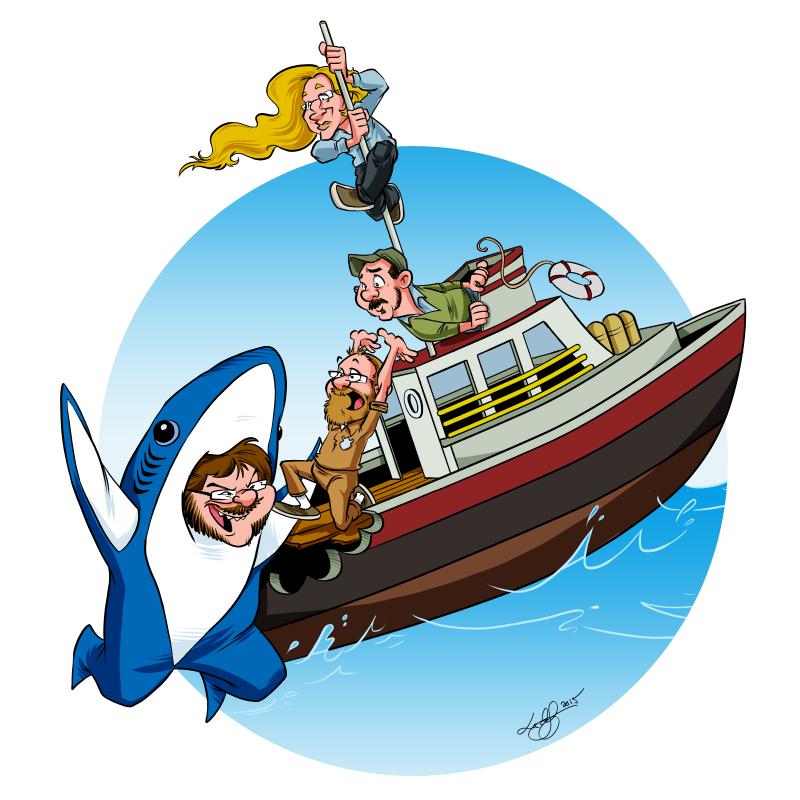
But it can also be a wonderland. Because without social media, I wouldn’t know so many amazing writers. I would have never spoken on stage at Margaret Atwood’s birthday. I would never get into a cold war of kale-related tweets with John Scalzi. I would never have gotten Lar deSouza to draw me on a wyvern with a jetpack:

Or me on the Jaws boat with Scott Lynch, Sam Sykes, and the aforementioned Scalzi:

I sometimes just wish for things on Twitter, and they happen. I say, that book looks neat, and then that book, which is months before publication, shows up at my door.

I know. This is supremely privileged. Not everybody can just shake Twitter and make cool stuff fall out, I do recognize this — but I’ve also seen it happen with so many others, too, whether it’s writers asking for critiques or when fans of authors get to meet and engage with those authors.

Social media can be really, really cool.

Which leads me to:

Project: Redacted.

On September 4th, 2014, I wrote this tweet.

On September 4th, 2015, this book comes out.

Which means that [REDACTED] has been revealed as not the PERFECT STRANGERS officially-sanctioned novelization that I’ve been talking about on Twitter (though one day I will write BALKI’S DAY OF BLOOD, you betcha), but rather revealed as:

STAR WARS: AFTERMATH.

*silent joyful screaming*

(News at StarWars.com. Featuring more info and thoughts from Yours Truly.)

I am writing an official Star Wars novel.

I am writing the first (newly) canonical novel set after Return of the Jedi.

I cannot feel my legs, and I have been drunkenly pirouetting wildly around the house for months, making lightsaber sounds and forcing my four-year-old on a steady regimen of Star Warsy goodness. I am geeking out hardcore over here. I now join the ranks of my homie, Kevin Hearne (who by the way just made the NYT bestseller list with Heir to the Jedi).

The opening crawl for Aftermath, should you care (and I can say no more):

Journey to The Force Awakens.

The second Death Star is destroyed. The Emperor and his powerful enforcer, Darth Vader, are rumored to be dead. The Galactic Empire is in chaos.

Across the galaxy, some systems celebrate, while in others Imperial factions tighten their grip. Optimism and fear reign side by side.

And while the Rebel Alliance engages the fractured forces of the Empire, a lone Rebel scout uncovers a secret Imperial meeting. . . .


In Which I Emit A Lot Of Grr-Talk About Your Writing Career

Here, have this.

It’s a Storify where I, for little to no reason, put on my ranty-trousers and danced around Twitter, grumping about Your Writing Career. (I’m embedding it below, as well, but embed efforts from some sites can be iffy here at the blog. So, assuming it does not embed correctly, you can use that link above. Feel free to embrace, ignore, or abuse accordingly.)

Writing Is A Profane, Irrational, Imperfect Act

Writing is a profane act.

I don’t literally mean in the FUCK THIS, SHIT THAT way (though for me that tends to be true enough just the same). But I mean profane in the classic sense: it’s a heretical, disrespectful act. Crass! Irreverent! Writing and storytelling is this… nasty task of taking the perfect idea that exists in your head and shellacking it all up by dragging it through some grease-slick fontanelle in order to make it real. You’re just shitting it all to hell, this idea. You have it in your mind: golden and unbreakable. And then in reality, ugh. You’ve created a herky-jerky simulacrum, a crude facsimile of your beautiful idea run through the copy machine again and again until what you started with is an incomprehensible spread of dong-doogle hieroglyphics.

The end result will never match the expectation.

You will never get it just right.

The idea is God: perfect, divine, incapable of repudiation, utterly untouchable.

The result is Man: fumbling, foolish, a jester’s mockery, a bundle of mistakes in tacky pants.

Nobody is good enough to tell the stories and ideas inside them. I mean that sincerely. The ideas in my head are shining beams of light, perfect and uninterrupted. And when they finally exist on paper, they end up fractured and imperfect — beams of light through grungy windows and shattered prisms, shot through with motes of dust, filtered up, watered down.

But sometimes that’s enough. Sometimes, a beam of light is still a beam of light no matter how diffuse it is, no matter how dirty the light, no matter how filthy the floor is that it illuminates. And when it’s not enough, you keep on trying until it is. Because eventually, it becomes that. The only reason it doesn’t become that isn’t a lack of skill or talent, but giving up before that lack of skill or talent shows up on the page. The only true failure is giving up and giving in.

I write this in response to a colleague who was talking on Facebook about the ideas in his head never matching the expression of those ideas, whether from a lack of skill or talent or intelligence. Thing is, it’s true. My colleague is right. Those things will never match. No matter how hard you try, because the only way to get our stories out of our heads and into your heads we first need to translate them into mundane language. And when you translate one language into another, you introduce imperfections, inaccuracies, misunderstandings. You move the Bible from Enochian angeltongue to Aramaic to Greek to Latin to English and you lose something vital — once, the Bible was about a guy named Dave who saved the Galaxy with his unicorn army. Now it’s blah blah blah something about “Jesus” and “loving one another.” Writing is always this: an adaptation of the sacred into smut. Dragging the divine out of his Sky Chariot and into the human dirt.

But me, I like that aspect.

I like making God into sausages.

I like dragging those angels down into the slurry, dirtying their wings, breaking their harps.

I like translating the beautiful celestial song and grunting it in our human chimp-shrieks.

Because that’s the only way it will ever exist.

Because if there’s one thing that is imperfect about perfection —

It’s that it’s too perfect to live.

It’s unreal. And I don’t truck much with unreality.

Writing unwritten is a promise unfulfilled. I’d rather make the promise and complete it badly than make the promise and never even try. A story untold is a life unlived. What’s the point? If you want to do this thing, you have to set yourself up against unrealistic expectations. You cannot combat perfection because perfection? That smiling, shiny jerk always wins. You do what you do, crass and irreverent as it may be, because committing heresy in the name of art is far better than huffing invisible God-farts and cleaving only to invisible philosophy.

We’re told to do no harm.

But sometimes, you have to trample pretty daisies to get where you’re going.

This also means setting for yourself realistic, reasonable metrics for success. A day’s worth of writing is a success. Finishing the thing is a success. Separate that out from the aspect of professional, business success. You can’t control that kind of success, though you can maximize your luck and that means first finishing what you begin. If you want to create? Create. If you want to write and tell stories, do that. Don’t give yourself over to unkind, cruel standards. Judge yourself fairly. Work despite perfect expectations. Those who try to master perfection will always fall to those who iterate, and reiterate, and create, and recreate. Art is better than philosophy. Creation, however clumsy, is always better than sitting on your hands and fearing what damage they can do.

Kill the perfect. Slay the angels. Fuck the gods.

You’re human. You’ll get it wrong. Everybody gets it wrong.

But getting it wrong is the only way you get close to getting it right.