Chuck Wendig: Terribleminds

Apple-Obsessed Author Fella

Archives (page 158 of 481)

Maurice Broaddus: Wrestling With Writer’s Block

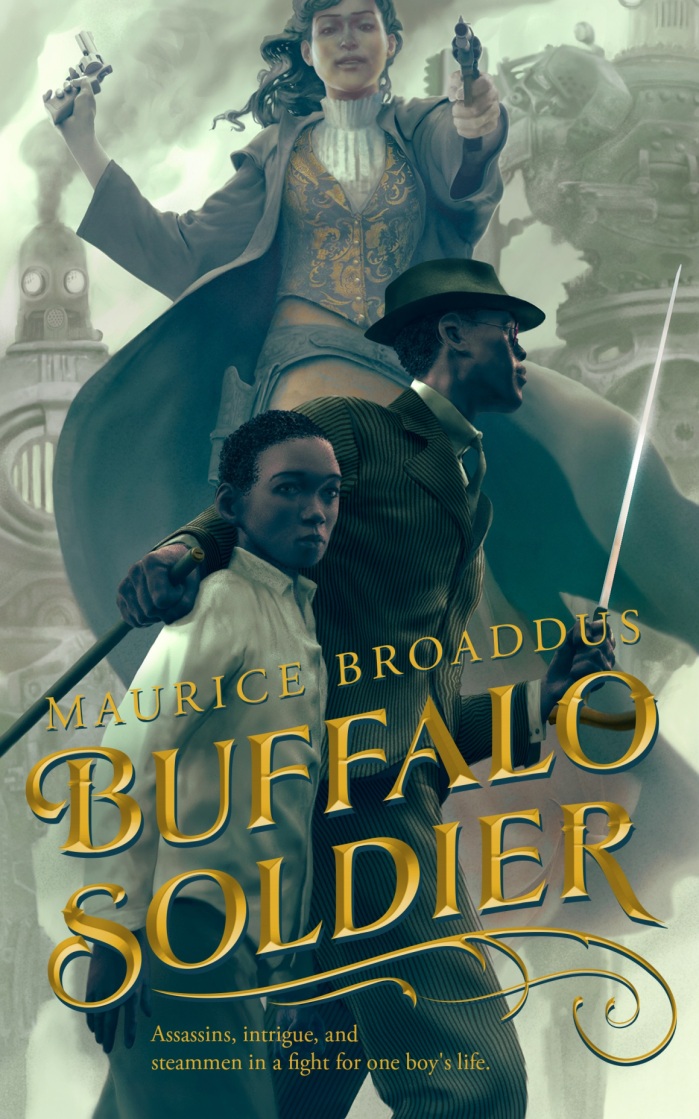
Maurice Broaddus is a rare treasure — the writer who is both nice as cookies in person and who is an authorial bad-ass on the page. His newest is Buffalo Soldier, and here he pops by to talk about the dreaded hell-beast known as writer’s block.

* * *

Like many writers, I’ve had to wrestle with the idea of writer’s block. Honestly, every time I sit down in front of a blank page, I have a flutter of anxiety, as if I may have forgotten how to string words together to form a sentence. At this point, I usually recall a comment my wife made early in my career:”we can’t pay bills with your writer’s angst.” Bills don’t wait on inspiration or the comings and goings of “my Muse.” To me, most times “writer’s block” is a romantic way to describe a story not being done yet, that the creative mind still had work to do on a project. Still, I’d say that I’ve had three occasions when I’ve experienced something close to true “writer’s block:”

1. King’s War (series wrap up). When I was set to write book three of my urban fantasy trilogy, The Knights of Breton Court, I was stuck. I had written the first two books, leaving strands of story lines and introducing characters which had sprawled all over the place. Somehow I had to wrap everything up in a fairly tidy bow…and I had no idea how I was going to write the third book. I didn’t even know where I’d start. Six months went by, the deadline starting to creep up on me, and not a word had been written down. I was word-blocked.

What snapped me out of it was something I couldn’t have planned for: I got into a fight with a friend. A horrible, end-of-the-friendship type argument, yet three-fourths of the way through the fight I think to myself “This is it! This is the emotional place I needed to write the third book from. This is where my characters are in the story.” So now I’m half arguing while trying to take notes so that I can remember all of this (which really didn’t help the fight/friendship situation). I drew upon a painful moment in my life and wrote from that place.

This is what I meant when I said that writer’s block stemmed from the fact that the story simply wasn’t ready yet. The story was still gestating in the back of my head and wasn’t going to be rushed. But all along, my brain was still doing the work of writing, fleshing out characters and thinking through the unfolding drama. Once I found the entry point to the story, everything else fell into place.

2. Life stuff. In 2014, one of my sisters was diagnosed with cancer and was given about a year or so to live. Life happens to all of us and previously when tragic circumstances have popped up in my life, it just became grist for the mill and I worked out my feelings in my writing. Writing has always been both therapy and release for me. It allowed me to put some distance between what was going on, and what I was feeling. It helped me to examine things from a variety of perspectives. This time, however, I couldn’t and everything just stopped. I stopped writing for 6-9 months. She passed in early 2015. After a month or so, I had the epiphany that she’d kick my behind if she knew I wasn’t writing. But when I sat down to write, I was hit by this fear of “can I even string two sentences together anymore?” Because I’d been away from writing for a while and had fallen out of the habit of my daily practices which help me against writers block.

What finally pushed me out of it was that I remembered that I function best when I have a deadline looming. So I went through my inbox and accepted any invitation that came my way. I went through calls for submissions and lined up nearly a dozen projects, some pretty random and esoteric but they allowed me to mark out deadlines and started grinding. The challenge of the various projects was its own kickstart.

3. Buffalo Soldier (a fear pause). I began writing an alt-history story involving an autistic child whose guardian takes him into Native American territory. The story obviously involved writing about a culture not my own and I struggled with questions: what if I get this wrong? What about cultural misappropriation? Is this my story to tell? What about race fail? These were all valid questions (and the issues surrounding how to “write the other” deserves its own blog post), but I hadn’t written word one yet. Ultimately I realized it wasn’t my fear of getting it wrong paralyzing me (that should give me pause). It was the fear of a lot of people (read: teh interwebz) falling on my head. I wanted to tell this story, but I had all of these voices in my head shouting me down, stopping the process. It was essentially the same as fearing critics (which shouldn’t give me pause). But with all of this outside anxiety in the form of looming social media fallout, I froze.

I fell back on an old technique practiced by ancient mystics called “turn off social media.” Oddly enough, all of those voices quieted down, and I had space to remind myself that I was a writer. Writing other voices is what I (am supposed to) do. This includes getting into other people’s heads and exploring other cultures. If I trusted my instincts and did my job as a writer (avoiding stereotypes and cliches; writing well rounded characters; checking in with those whose cultures I’m writing about and listening to their critiques), I should be okay. Don’t get me wrong, we will always get something wrong when it comes to writing the other, we just need to listen to the critiques, learn from them, and fail better next time.

The threat of writers block always looms. It can take a variety of forms from not having an idea to explore, to not feeling like writing, to feeling like you have nothing worthwhile to say. Writer’s block tells us something. Maybe that the story is not ready yet or that the idea is not viable. When I come to a blank page, I spend a lot of time beforehand arming myself. I have research. I have brainstorming notes. I have snippets of dialogue, a rough outline, and description all so that I can avoid any sort of block. My actual writing routine involves preparation the night before: thinking through what I’m going to write, making a plan, mapping out the scenes or chapter. When I’m writing, I might stop mid-paragraph or mid-scene rather than write them to completion so that when I can sit down again, I can slip right back into what I was writing. I may have multiple projects going so that I can switch to another should I get stuck on one. I prepare, prepare, prepare … whatever it takes (whatever works for me) — both in rhythm and habit—to keep putting words on a page. It may not just be writerly angst, but it can be worked around. Your mileage may vary, but give yourself space and time to work your story out.

And be kind to yourself while doing it.

* * *

Maurice Broaddus: Website | Twitter

Buffalo Soldier: Amazon | B&N | Indiebound
Macro Monday Goes Big And Then Goes Home

MY EPIC JOURNEY IS COMPLETE.

Okay, not that epic in the grand scheme of things, but epic enough for me —

In addition to ending up at Wondercon and SWCO, then in the subsequent week I left for LA, and stayed out West for two weeks. Therein I hit LA Times Festival of Books, StokerCon, and the Northern Colorado Writers’ Conference in Fort Collins. I passed through and stayed in Vegas, Moab, Ouray, and Denver.

I got to be on a ghostly Murderboat; I hung with pals like Ben LeRoy, Brian Edward Hill, Holli Moncrieff, Bill Bridges, Matt Fucking Wallace, Stephen Blackmoore, Paul Tremblay, Nika Harper, John Scalzi, Dan Goldman, James Sutter, and Kevin Hearne, and more; I came to the realization that extraterrestrials are totally trending again; I slept in a hotel room with paper thin walls and heard a threesome unspool at 4:30 in the goddamn morning; I threw dice with George R.R. Martin; I killed a man in Reno just to watch him die; I ate a donut covered in Fruity Pebbles; I realized Hershey’s chocolate now tastes kinda pukey; I signed a lotta damn books; I killed another man in Reno, this time for his Nintendo Switch; I had a revelation about sadness and beauty; LeRoy and I tried to master the art of astrophotography and we came up woefully short with a great many photos of dire fucking darkness; I tamed a ghostly elk and it showed me the way to a canyon where I made love to a waterfall and learned the secrets of the universe; I traveled first class on a plane for the first time and enjoyed the complimentary prostate massage by an ancient purveyor of the art; I drove a total of 1200 miles; I came home.

You can see the Flickr album of the trip here.

Please to enjoy.

Sked, Stuff, And Other Updatery-Doo

17992315_10212175515361361_5517698298479488630_n-2

*unhinges jaw*

*disgorges information into your eyes, blinding you*

OKAY SO HEY.

I’m putting terribleminds on a two-week hiatus because, well, I’m gone for two weeks.

That may change if I have a steady, consistent ability to log on at a distance and make updates, but that is rarely a guarantee whilst on the road due to the way I lockdown access to the site, so it’s more likely we’ll just let the blog be quiet for a couple of weeks. It will sleep. It will wait.

It will grow hungry.

In the meantime, I’ll be at:

Los Angeles Times Festival of Books (LATFOB)!

My sked there is for Sunday, April 23rd only, and includes:

12:00 (noon): Panel & Signing, SLIGHTLY SURREAL FICTION, moderated by Kate Maruyama, with panelists moi, Paul Tremblay, Matt Wallace, and Brian Evenson. It’ll be a panel, audience Q&A, and a signing after.

2:00PM: Signing #2! This one is at the Mysterious Galaxy booth, #368, and goes to 2:45.

Then I shall kick around LA for a couple days, until it’s time for…

Stokercon!

I’ll be at Stokercon, guest-of-honoring in the shadow of mega-ultra-guest-of-honor, George R.R. Martin, who I’m excited to meet not so much for that whole ASOIAF thing, but for Wild Cards! And Fevre Dream! The Armageddon Rag!

My schedule there is:

Friday, the 28th

10-11AM, mass signing in the dealers’ room

1-4PM, sitting down to play Werewolves of Los Angeles in a Werewolf: the Apocalypse session storytold by WTA ringleader and buddy, Bill Bridges, and featuring fellow players, GRRM, Nancy Holder, Maria Alexander, Stephen Graham Jones (!).

6-8PM, Shades & Shadows open reading

Saturday, the 29th

10-11AM, Panel: Writing Fiction vs Writing Games

1-2PM, Panel: Writing for Licensed Properties

Otherwise, I’ll be at the other group events, and I’ll be hanging out, just gettin’ weird on an apparently-haunted boat? That’s good, right? I’ll try not to accidentally host any demons in the cauldron of my mortal flesh.

After Stokercon, I go on a —

Long-Ass Drive

I’m driving from CA to CO. I’ll probably be pinging my way from Vegas to Moab to Ouray, and then onward across the goodly state of Colorado to my next and final event of the trip —

The Northern Colorado Writers Conference

Yep, I’m the keynote speaker at the conference — in which I will share my dubious wisdom.

Friday 6:30 – 8PM: Dinner and my Dubious Keynote

Saturday 8-9AM: Author Panel!

Saturday 9:30 – 11AM: Character-Driven Plotting, my class

And then I fly home!

Let’s see, what else is going on?

Updates!

STAR WARS CELEBRATION was genuinely sublime. I remain filled with such gratitude not only to LFL and Del Rey for having me play in their sandbox, but also to the fans who came out — it was a non-stop love-fest, lots of joy for Aftermath and lots of geeking out over the wonderful galaxy of stories that is Star Wars. I got to be on the Star Wars show with Carboni and DeGoots. I stood near John Boyega. I got to sit in a landspeeder and give an interview to SyFy. I got to do a trivia panel with galactic bad-ass, Tim Zahn. I met Steve Blum. I saw a SEEKRIT Weird Al show at the 501st party, with bonus Billy Dee Williams sighting. I got to hang with Delilah Dawson, my spider sister from another mister, who is also writing the Phasma novel coming out in September. And I got to be Cool Dad and bring my family to the event, where my son cosplayed for his first time as Tatooine Luke. It was awesome. I wish I were back there still.

Oh, I also did this interview for Glixel / Rolling Stone, by the way. GO READ IT.

What else? I turned in a draft for my next writing book, which is less about writing and more about storytelling — that book is called DAMN FINE STORY, and should be out (mumble mumble) in the fall? I’ve seen the cover and the cover is weird in the best way.

I also got edits back on The Raptor & The Wren.

I’m writing Vultures now.

Scheming Exeunt.

Writing secret comics project.

Yadda yadda etcetera etcetera.

Ooh ooh ooh, one more thing:

I got to write a cool essay regarding Neal Stephenson’s Snow Crash, and what that book meant to me when I read it, and what it means to me even now. Go read that, too.

Clark Thomas Carlton: Let’s Not Be Like Ants

To coincide with the March for Science tomorrow (during which I will sadly be in the air, on a plane), Harper Voyager is having some of its authors talk about science and politics, and one of those authors is Clark Thomas Carlton, who has written his own spin on an ant novel, Prophets of the Ghost Ants. Here are some of his thoughts on ants, science, and politics for the Harper Voyager Science Fair!

* * *

The Bible tells us, “Go to the ant, thou sluggard; consider her ways, and be wise.” But let’s not be like ants this Earth Day. Or any other day.

Ants and humans are the only two animals on the planet to engage in warfare according to myrmecologist Mark W. Moffett. Other animals may fight, skirmish or even kill each other, but only antkind and humankind organize into armies of hundreds, thousands or even millions to battle for a decisive outcome. Both are hardwired to aggressively expand their territories and mark their borders with materials. And both live in settlements — ants live in nests and humans live in villages, towns and cities. According to Dr. E.O. Wilson, the Second Darwin, the adaption of settlement life led to a subsequent division of labor which is part of why humans and ants go to war — the former send mostly young men into battle and the latter send their “old ladies.”

Humans and ants make warfare for all the same reasons — to expand or defend their territories and to bring back food and other resources. Some ants, like humans, war to take slaves. The end result of wars is that the victors maximize their reproduction and, by extension, the replication of their genes. Close to 14,000 documented species of ants make up about ten percent of the terrestrial biomass which makes the ant a very successful animal. Homo sapiens, another very successful animal, have also improved their survivability by evolving into a warrior species with cooperating individuals. Our desire to use ever better weapons in our wars has always been an essential part of improving our technology. In taking us from metal tipped spears to the hydrogen bomb, we have created other wonders along the way as diverse as cotton gins, popsicles and cars.

As a result of our ability to adapt to different environments, seven billion of our successful human selves have spread to almost every part of the planet and brought our fires, our combustible engines and our coal burning power plants. The result of this expansion and its companion technologies is that we have filled our atmosphere with more than 400 parts per million of carbon dioxide which has initiated a global warming. That’s not news, of course, but some still insist that climate change is a hoax. A very simple experiment can be conducted in a home laboratory to show that ice will melt faster in a heated glass box with a higher concentration of carbon dioxide in its air. The ice will melt even faster in a box mixed with methane, a gas all of us create daily at both ends of our digestive tracks. Methane is being released in alarming amounts as the permafrost in Siberia melts.

Rising temperatures are not a real threat to Planet Earth, which will remain in some form. The threat is to the billions of humans who live here now and, even more so, to their immediate descendants. In the Anthropocene Era, we are plunging headlong into an epoch of mass displacement and famine. The end result will be unending civil and international wars. The casualties of these conflicts will dwarf the numbers lost in World Wars 1 and 2. The end of the 21st century may mean a complete redrawing of the global map —

If maps are going to be drawn at all.

* * *

Due to the arcane nature of something called The Electoral College, the infrequent occupant of the Oval Office is a member of the subspecies homo golf cursus. The Putter-in-Chief has called the crisis of climate change a “hoax created by the Chinese.” This is the worst possible leader that we need at this time, a bad hombre who gives into his every selfish impulse including extramarital exploits. Part of his personal expansion is a business empire, which includes buildings that mark his turf, and even more flagrantly, golf courses where a sport is played that is the most territorial of all pastimes. Golfing alpha males carry sophisticated versions of the caveman’s clubs as they roam an oversized lawn that is not cultivated for food or housing but for a trivial contest played by members only. Golf courses may be repurposed by global warming yet.

A recent study by the U.S. Geologic Survey predicts that as many as one billion people living on the coasts are threatened by the rise of sea levels due to melting ice sheets and the polar ice caps. After Miami, Guangzhou and Mumbai become uninhabitable, their citizens will not sacrifice themselves for the greater good and submit to drowning. They will push into dry areas. Fleeing humans won’t be allowed on to arable farmland which will be under stress to feed a burgeoning population of humans. The dislocated could end up squatting on golf courses, among other places, where they will build shanty towns, drink from the water traps and scrounge for squirrels and slaughter the swans. The ants will join them and in a desperate measure to feed themselves, the displaced humans will make like chimps and dip twigs into anthills in order to eat them.

Scientists tell us it’s unlikely the Earth will ever become a kind of Water World — at least not for the next two billion years. But the coming disruption to life as we know it cannot help but end in struggle, disease and war. It may result in a divergence in our species with the rise of homo survivalus. They would be descended from humans with enlarged amygdalae and its associated paranoia that forced them to flee the cities for isolated locations where they have stored their guns and ammunition and a few years supply of food. Homo survivalus won’t be defending his food and territory from homo chardonnayus, the rich liberals living inside the East and West Coast Bubbles. The Bubbleites will have retreated to their second homes in the mountains of Aspen and Stowe. Homo survivalus will be aiming his gun at the masses of poor and homeless who will break down his fences in search of something to eat and a place to lay their weary heads.

* * *

In California where I live, it has been decades since I have seen any of our native carpenter and harvester ants. The only ants we ever see anymore are invaders: Argentine ants and the red imported fire ant. How they got here is not completely known but it was not a plot they thought up — ants are terribly limited in their thinking abilities. They have no culture, no morality, and do not make choices about how and where to reproduce. Ants can’t help but to create new colonies and can’t help but to defend their nests. They can’t resist attacking other ant nests in order to destroy them, eat their larvae for lunch and then assume their territory.

Most ants not only attack other species of ants but will attack rivals of their own species whose scents differ by a few molecules. The Argentine ant is one of the exceptions. As tiny as their worker/soldiers are, they have become the most dominant player in our state, with a massive supercolony extending from Mexico to San Francisco. Their uncountable trillions of ants in millions of different colonies accept each other as kin and their millions of egg laying queens maintain a chemical truce. The Argentines have won billions of wars with an unstoppable army.

In order to make war, humans have to “otherize” the enemy. We view other groups as lesser and different due to cultural and physical differences that have developed, mostly, in geographic isolation. But we are all the same species or we couldn’t interbreed. The establishment of the United Nations was an attempt to come together as a single human tribe and end any more wars. More recently, the U.N. took an official position on global warming as an extension of this goal: “Take urgent action to combat climate change and its impacts.”

Most of the developed and educated nations of the world are accepting their responsibility for a changed climate and most are working to reduce their carbon footprints. But for the first time, these progressive nations are looking at the United States as something of The Other — as a nation falling backwards, committed to a willful ignorance and using the fictions of religious scripture to justify our abuse of the planet. Conservative radio host Rush Limbaugh told his listeners “It is my devout belief in God that gives me every bit of confidence that man is not destroying — and furthermore, cannot — destroy the climate.” The wealthiest nation in the world that once put a man on the moon has allowed an incurious, inept opportunist to become its leader. Our president is a climate change denier whose endless greed has cheated thousands out of their money in order to fly in his jumbo jet to his different golf courses.

Our planet is being ruined by those of us who fail to hold back on our natural impulses, who want to win, win, win without regards to consequences. Unlike the ants, we can overcome our innate instincts and can moderate our behavior — we can do the right thing for our human family of seven billion and growing. Part of the right thing means limiting the number of our offspring and making better choices as consumers. We can invest in an array of solar panels, choose an electric car over a Cadillac Escalade, or buy a sailboat instead of a powerboat. We can give up meat and take public transportation. We can solve any so-called housing crises not by building more houses and destroying more forests but by having fewer children. We can maintain a habitable, peaceful and beautifully diverse planet by choosing the welfare of the global tribe over the pleasures and power lust of a few individuals.

Ants will never change their ways — they can’t be talked out of their next war of expansion or reproductive rate. Humans will never get over our natural impulses to conquer and subdue but we can choose not to express them. Instead of acting on our impulses, we can sublimate them through violent, smutty novels, movies and television, video games, chess and checkers. We can indulge our desire to battle by watching or playing sports where “tribes” or individual “warriors” represent different settlements and engage in a substitute for combat. One of those “sports” can be played by people well into old age: so if you have to, go play some fucking golf.

See you on the links.

Clark T. Carlton is a journalist, screen and television writer and an award winning playwright and novelist. He was born in the South, grew up in the East, went to school in the North, and lives with his family in the West. As a child he spent hours observing ants and their wars and pondered their similarity to human societies.

Prophets of the Ghost Ants: Amazon | Harper Voyager

Dan Koboldt: Five Things I Learned Writing The Island Deception

What happens in Las Vegas stays in Las Vegas. But what happens after you step through a portal to another world, well…

For stage magician Quinn Bradley, he thought his time in Alissia was over. He’d done his job for the mysterious company CASE Global Enterprises, and now his name is finally on the marquee of one of the biggest Vegas casinos. And yet, for all the accolades, he definitely feels something is missing. He can create the most amazing illusions on Earth, but he’s also tasted true power. Real magic.

He misses it.

Luckily–or not–CASE Global is not done with him, and they want him to go back. The first time, he was tasked with finding a missing researcher. Now, though, he has another task:

Help take Richard Holt down.

It’s impossible to be in Vegas and not be a gambler. And while Quinn might not like his odds–a wyvern nearly ate him the last time he was in Alissia–if he plays his cards right, he might be able to aid his friends.

He also might learn how to use real magic himself.

1) There’s No I in Team, but Three I’s in Centipede Infestation

When I first wrote the manuscript for The Rogue Retrieval, I was a team of one. I wrote the book at my own pace, with no deadlines other than the somewhat-arbitrary ones I set for myself. I didn’t have anyone to go to for feedback, either. There’s a lot of freedom that comes with writing a book on spec. If I failed, no one would ever know. I didn’t have that luxury with book number two. Instead, I had critique partners, an agent, an editor, and maybe even a few fans.

I still had to write the book, but when I was done, I knew that members of my “team” were going to read it. That raised the mental stakes: when I finished a scene or chapter, I wondered whether or not it was good enough to live up to expectation.

The ugly centipede of self-doubt can be crippling for any writer. Fortunately, the simple fact that people were expecting that next manuscript created enough urgency to keep me going. Centipedes be damned.

2) Face Your Weaknesses

Every writer has strengths and weaknesses. Some of us write slow openings, but killer endings. Some of us are great with narration but struggle with dialogue. Over time, you learn your particular weak points and try to give them more attention. For me, plot-wise, the middle is the hardest part. That gets complicated for book #2 in a planned trilogy, because the ENTIRE BOOK is a kind of middle. How much do you give away? How much do you hold back? I asked myself these questions over and over.

The good news was that, thanks to item #1 above, I had people around to point out my weaknesses. My editor (David Pomerico) is very good at finding them, and steering me in the right direction. Also, because he’d read my outline for the whole series, he knew when I was trying to hide things that I shouldn’t.

The lesson here is that you should find people who know your weak points. Listen to them and pray they don’t sell you out to your enemies.

3) Punctuation Is Hard

As I wrote in my previous guest post for Terribleminds, copy editors can do wonders for taking you down a peg. Having learned many grammar and punctuation lessons embedded in my 1,500 copy edits for The Rogue Retrieval, I felt all but certain I’d do a much better job this time. Many of the corrections addressed minor formatting issues I could preemptively fix before the editors ever saw it. That should make for a much easier copy edit, right?

Sort of. The manuscript for The Island Deception came back with 1,200 copy edits. In some cases, I tried to fix a formatting issue but only made it worse. But most of the copy edits were punctuation-related. A lot of my commas get moved around, but the hyphen/em-dash is my absolute bane. At this point, I feel like I’ll never learn it fully. That’s why we have copy editors.

4) Lie, Cheat, and Steal

My main character is a Vegas illusionist, someone who deceives people for a living. In the first book, I enjoyed putting that skill set to work. With book two, I wanted to take it up a notch. The word deception is right there in the title. So I made my MC lie and cheat like his life depended on it, which did. What surprised me about writing that was how much I enjoyed myself doing it.

We penmonkeys are all liars to a certain extent. And we often put a little bit of ourselves into our characters. Mine is charming, persuasive, and willing to put in the work to excel at his job. He’s the guy I sometimes wish I could be. That makes writing him a hell of a lot of fun.

5) Leave It All on the Table

By the time I sent off the manuscript to my editor, I felt like it was in good shape. It had passed through the gauntlets of two critique partners; even my agent called it “pretty clean” (coming from a literary agent, this is a compliment). Imagine my surprise when I got a seven-page edit letter. My editor said look, if you give this a light polish it’ll be a good book. But if you’re willing to dig deep and put in some hard work, I think it could be great.

Those edits took two and a half weeks of round-the-clock work. By the time they were done, I had ants crawling out of my eye sockets and wanted to set fire to the world. But I’d put in the work, and the book was better for it. I figure it puts me one step closer to the character I’d like to be.

* * *

Dan Kobolt: Website | Twitter | Facebook

The Island Deception: HarperCollins | Amazon | iTunes | Nook | Kobo | Google

Elizabeth Vaughan: Five Things I Learned By Writing Wardance

Wardance-Cover700pxW

Spring returns to the Plains, and with it, the Time of the Challenges, when warrior fights warrior in a contest for rank and status. For Simus of the Hawk, now is the time to raise his challenge banner, to fight for the chance to finally become Warlord. 

But his deadliest challenge does not come from other warriors, or even the sundered Council of Elders. For on the first night of the Challenges, a mysterious and deadly pillar of white light scorches the night sky—instantly changing everything for the People of the Plains.

Now a warrior-priestess, Snowfall, stands before Simus, who dares to speak of peace, of reconciliation. Her knives are sharp, her tattoos alluring, and her cool grey eyes can look through Simus and see…everything.

Now Simus and Snowfall must solve the mystery of the pillar of white light, and protect their people from all the destruction and chaos it brings. Snowfall fights for her place beside Simus, despite resistance from friend and foe.

The warrior-priests have abused their power for many years. Can Simus face the challenge of trusting Snowfall with his honor? And perhaps . . . with his heart?

1.  Persistence is the name of the game.

Yeah, butt in the chair, fingers on the keyboard.  I have to write and write and write some more to get words on the page that I can fix.  And sometimes sitting with the laptop on my lap and staring at the wall is writing.  So are all the little scribbled notes that I stick in my purse.

Thinking about the book, the story, the characters every day.  Not letting myself get distracted by TV, movies, video games and other people’s books.  Because it is so much easier to consume rather than produce.  And creation is hard.

And while I know that – knew that from experience from all my prior books – it seems I have to be re-taught this lesson every single time I sit down to write another book.

You would think I would learn.  But noooooo.

2.  OMG, I am waaay too nice to my characters.

I take them out for long walks, and picnic lunches where everyone talks over their problems and after a bit of discussion, come to an agreement.  They tell jokes, make sheep eyes at each other, and express concerns over their issues.

Bleh.

I usually have to stop myself, take a deep breath, then set the picnic basket on fire, throw rocks at the characters,  run them up a tree, and then set fire to the tree.  Drama, excitement, suspension, those are emotions that make a book.

If the characters are going to declare their undying love for each other, it is far more interesting and satisfying if they do so while under the threat of death, dismemberment, or being ripped from each other’s arm by some other really bad thing.  But dang it, I usually only figure that out in the 2nd draft of the book.  See paragraph 4 below.

3.  My sub-genre may require a HEA for the main characters, but secondary characters are subject to RIF without notice or hearing.

True story – when I was first published I went to a meeting of our local romance writer’s group.  Someone asked me how the latest book was going and I said.  “Good, but I don’t think I have enough red shirts.”

Dead Silence.  Blank stares. (Mind you, this was in 2005)

So I explained the concept of red shirts; ie: Not a big enough body count.

Dead Silence.  Blank stares.

Then someone broke the silence and asked ‘you are writing a romance, right?’

Yup.  But that doesn’t mean that heads aren’t gonna roll.

Understand that in romance there is a contract with the reader that at the end of the book there will be a HEA.  Happily Ever After.  And I love happy endings.  Which is why I write romance.  The hero and heroine will be in love, and in each other’s arms, and while facing challenges will do so together, forever.  Smoochy-smoochy.

Secondary characters?  Not so much.  No contracts.  No promises.  Off with their heads, and such other body parts as to make the story interesting.  See paragraph 2. above.

Now, if the secondary characters live long enough to get their own books in the series, well, okay.  They are granted immunity and their own HEA.  Still might hurt them a little bit, tho. Just to keep things interesting.

Oh, and the world behind the hero and heroine?  Turmoil, chaos, a ripping apart of the old ways and traditions.  Yup, that’ll do ‘er, as I like to say.

So.  Hero?  Safe.  Heroine?  Safe.  All the other characters?  I wouldn’t trust me, if I were you.

4.  The story is not about how my monsters breed.

Wyverns!  Big, nasty creatures with teeth and claws, a wicked stinger and a bad attitude.  I spent lots of time designing my wyverns, their mating habits, their migratory patterns, their . . . .

Except that is all back story, dang it, and since it doesn’t matter for the plot I shouldn’t spend two weeks agonizing over their mating habits.  Because doing that research, watching Youtube videos of reptiles eating their prey, that is not advancing the plot, it is not getting words on the page, it is not getting the book written.  Dang it.  See paragraph 1. above.

But I kept all my notes, because you never know when a wyvern might swoop in and bite someone’s head off.  Just sayin’.  See paragraph 2. and 3. above.

5.  I learned how much I love writing.  Even the painful, horrible revision bits.

I normally do four drafts.  The first draft, wherein the characters picnic and are nice to each other.  The second draft, based on my writer’s group comments, wherein the characters suffer more and the plot really gets knitted together.  Then the third draft, based on the editor’s comments, wherein the book becomes sparkly and worthy of publication.

This book went through three extra editorial drafts.  Thank God above for editors who push and push and push until the book is everything it can and should be.  Editors who tell you that you are wonderful even as they are pointing out all the flaws.

I will be very honest here, and I am not the first person to voice this thought.  No one wants to write a book.  Everyone wants to have written a book.  Because it’s hard and while there is joy in the creation, there are painful bits to the process.  But when the labor is done, and the book is printed out and sitting on your desk, there are no words to describe the pride, elation, joy and pure relief an author feels at that moment.

At least, until the copy-editor gets their hands on it.

* * *

Elizabeth Vaughan: Website

Wardance: Amazon