Apple-Obsessed Author Fella

Category: The Ramble (page 201 of 478)

Yammerings and Babblings

V.E. Schwab: Books As Bodies (And Other Thoughts)

V.E. Schwab’s work is — you know what? Let’s just say it. I’m jealous! She’s younger than most of us and certainly more talented and damn her for her mad skillz. Her books are so good, it’s not fair. *throws short tantrum* Ahem. So, in the hopes that her ability will magically fill the air like a miasma and I can run through it and absorb some via osmosis, I am glad to host her here in a short interview with her Tor editor, Miriam Weinberg. Please to enjoy. 

* * *

V.E.: Let’s get down to business. Are my first drafts really as bad as I feel like are?

M.W.: No, they are not! Authors spend so much time considering their work–in ways both positive and negative. But specifically, it’s easy to get stuck in the space of second-guessing your own effect on the narrative, and whether it measures to your expectations. Authors (in first pass stage especially) tend to basically wring words and emotions out of themselves to the page, like a wet washcloth, until you’re a wrinkly crumpled mess.

V.E.: I do have a super weird relationship with my books, in that I forget that I’ve written them, and then forget that I’ve ever edited them. Once I’ve survived, I block it all out so that I can start the vicious cycle again 😉

M.W.: Do you ever go back and re-read post publication?

V.E.: The only one I’ve re-read is VICIOUS.

M.W.: And did you nitpick it?

V.E.: I didn’t. Of all my projects, I think that one is as close to technically flawless as I can get. Which is not to say it’s perfect, of course, but I tend to go back and wish I could change foundations, and I feel like the foundation of that one is super solid.

M.W.: I want to return to your writing process because I think your underpinning method is so integral to your books. You’ve talked before about layering muscle on top of bones. Is that how you think about writing, or is it just your Hannibal-esque brain?

V.E.: I know I skew toward the morbid, but I actually do think of my books as bodies. The first draft is for forging bones, the subsequent ones are for adding muscle, tendon, flesh. If you try to write the skin (or, you know, the top layer, the polish) before you have your bones, it will never hold together.

M.W.: Heh, your books are all creepy in some way, even when they’re funny.

V.E.: I like the dark humor. Like when you laugh and then feel bad about it.

M.W.: What do you think is the most essential part of the authorial process?

V.E.: Revision, hands down. It’s trite to say that writing is rewriting, but it’s true. If first drafts are for laying bones, then everything that comes after is for bringing the body to life. That’s where having an amazing editor is key. One that keeps you afloat while telling you everything that’s not working 😉 You never give me the answer, but you always ask the right questions.

M.W.: Aw, thanks :*)

M.W.: So, what is the part that you find that most frustrating?

V.E.: I have a complicated relationship with the first draft. On the one hand, it’s freeing, but I always want the first draft to have all the layers, all the twists and turns, and there’s this chasm between knowing what’s wrong, and being unable to fix it. I spend most of my first draft frustrated with that inability.

M.W.: You take your writing time very seriously, and you follow the method of treating it like a daily job. So how you do you deal with self-imposed deadlines, and what happens when you can’t get the words down?

V.E.: Massive feeling of insecurity.

M.W.: Haha.

V.E.: Yeahhhh.

M.W.: WHOMP. Okay, let’s talk about the evolution of the Shades of Magic series!

V.E.: Hard to believe that this little seed of an idea—the image of a man walking through a wall and colliding with a girl dressed as a boy—grew into a massive story with a cast of characters set across not one, or even two, but four Londons.

M.W.: It’s been so fun to watch it grow, too. The revision process was awesome–it makes me so happy that you and I both love getting into the serious depths of everything–Rhy’s insecurities vs. Kell’s, what the Arnesian landscape looks like, and particularly the cross-world linguistics!*

V.E.: What are you most excited about readers discovering in AGOS?

M.W.: I’m just really excited that we get to expand everything; from character depth, to action, to world expanse. The conceit of this world is obviously super fun, with all the Londons, but I’m so excited to see beyond the Arnesian empire, to meet the other countries, and to get to know the world that Kell and Rhy have grown up in, which is so like and so different to our own.

Also, there are a couple scenes I’m really excited for readers to discover. Lila! On a boat! A romance between the prince and an old fling. Lila and Kell together again! MAGICAL TOURNAMENT.

Bonus round! 

Hogwarts House?

V.E.: Slytherin.

M.W.: GRYFFINCLAW.

V.E.: You’re a Slytherin.

M.W.: um, *maybe* if I’m a Slytherin modeling Ravenclaw …I’m too Gryffindor to live, but too Ravenclaw to die 😉

Favorite tea?

V.E.: Eateket’s English Breakfast.

M.W.: ooooooh wait me too! Alternately, Seabreeze, from Spices and Tease.

City you’d love to live in?

V.E.: Edinburgh.

M.W.: …..dammit, Schwab, stop answering my answer. MIND MELD IN FULL EFFECT. But also, Melbourne, and Amsterdam.

Lastly, what do you want to see more of in genre?

V.E.: I’d love to see more monsters. (M.W.: OF COURSE)

M.W: I’m really excited to see, at least in the wider market,  a resurgeance of space opera, also, WITCHES, since I love both of those– but I’m most excited by the broadening of voice and setting in SFF (for instance, obvious UPDRAFT pride aside, the Nebula ballot is super exciting to me, and I hope that spread continues).

(Note: If you are curious about the language of the Londons, see this post No Mother Tongue: Language In The World of Magic.)

* * *

A Gathering of Shadows: out today!

Four months have passed since the shadow stone fell into Kell’s possession. Four months since his path crossed with Delilah Bard. Four months since Rhy was wounded and the Dane twins fell, and the stone was cast with Holland’s dying body through the rift, and into Black London. 

In many ways, things have almost returned to normal, though Rhy is more sober, and Kell is now plagued by his guilt. Restless, and having given up smuggling, Kell is visited by dreams of ominous magical events, waking only to think of Lila, who disappeared from the docks like she always meant to do. As Red London finalizes preparations for the Element Games-an extravagent international competition of magic, meant to entertain and keep healthy the ties between neighboring countries-a certain pirate ship draws closer, carrying old friends back into port.

But while Red London is caught up in the pageantry and thrills of the Games, another London is coming back to life, and those who were thought to be forever gone have returned. After all, a shadow that was gone in the night reappears in the morning, and so it seems Black London has risen again-and so to keep magic’s balance, another London must fall.

A Gathering of Shadows: Indiebound | Amazon

Macro Monday: The Cradling Hand

I kinda love that shot.

The tendrils of the maple leaf, the soft lace of the snow.

Winter here seems to be fast retreating — this morning, the songbirds outside are distinctly not of the winter variety. And last week I saw a veritable fuckdumpster of robins (which is their collective noun, by the way — a murder of crows, a parliament of owls, a fuckdumpster of robins). I am more than happy to be shut of winter, for winter is crap.

Oh! Real quick, some folks have been asking what macro lens I use.

It is this one: Canon 100mm macro lens. It’s heavy as a brick, and I think there’s a newer, lighter iteration? I’d love to get a rig set up that lets me get even closer to the bugs and snowflakes and waterdrops (the Canon 65mm MP-E is an option, I think) but that is a problem for Future Me (and likely a costly problem, though maybe there are ways to rig it more cheaply).

ANYWAY, HEY IN CASE YOU MISSED IT, SOME NEWS.

There is totally gonna be a Force Awakens five-issue comic adaptation.

The mighty Luke Ross is gonna draw it.

And apparently, some chucklehead is going to write it.

THAT CHUCKLEHEAD IS ME. CHUCKLEHEAD WENDERG. WOO.

First issue is already (mostly) in the can, and I’m cracking along on the next couple. And ICYMI, The Shield #2 came out last week, and Hyperion #1 comes out in March. I have officially stowed away on this boat and am hiding amongst other comic book professionals and hopefully they don’t find me and jettison me overboard.

That’s it. Enjoy your week.

*waves*

*sinks into the sea*

*bubbles and brine*

(P.S. this is the last week that a lot of my books are on hella sale, so go grabby)

Flash Fiction Challenge: Post An Opening Sentence

This one is pretty simple:

Write an opening sentence.

Post it in the comments below.

Any genre will do, really, though versatility has value.

The sentence should be on the shorter side. Let’s say, mmm, no more than 25 words. Some things to avoid, since sometimes folks fall into these traps: avoid blood, death, dead people, kids being hurt, and so forth. Think original. Conceive of a sentence that, when crafted right, is a strong hook. The kind that makes people want to read further. It makes them want to know more. Compelling and maddening in equal measure.

By next Friday, I will pick between five and ten I really like, and I’ll pop them into next week’s challenge, and you guys can choose one of those I pick to serve as the opening sentence to a new piece of flash fiction.

Today, no story necessary, though.

Just an opening line.

Due by next Friday, 2/26, noon EST.

Andrea Phillips: Throw Everything At The Wall

Andrea is a friend and a talent and initially when she sent me a guest post that said throw everything at the wall I assume that meant she was offering advice for how to deal with the frustrating realities of being a writer (“JUST BREAK EVERYTHING AND YOU’LL FEEL SO MUCH BETTER”), but her advice is far broader and, well, more useful than all that. Anyway, here Andrea talks about the willful messiness of a writing career: 

* * *

Sometimes, when I talk about all the different kinds of work that I do, I think I come off like a lying liar.

See, I’m here today to promote my brand-spanking-new project, The Daring Mermaid Expedition, which is a choose-your-own-adventure-style game except convenient app form. An interactive novel, if you will. It’s about mermaids and academia and pirates and loyalty. It’s funny and fluffy and… pretty weird, I guess? Also fun. And you can play the first couple of chapters for free!

Buuuuuut I’m not actually going to talk about my game. PSYCH! Ha ha promoting your work is hard.

The most perceptive of you throngs of Wendigites will recall that the last thing I was here trying to con you into buying was something completely different: Revision, a snarky sci-fi thriller about a wiki where your edits come true.

And my record only gets weirder from there. I’ve done nonfiction, and spent a while as a leading world expert in transmedia storytelling. I’ve written children’s books! Entertainment marketing campaigns! I’ve written smut under a pseudonym! Blog posts, alternate reality games, poetry, fitness games, old-fashioned paper newspaper articles, catalog copy. I’ve even written ye olde search engine optimization. (Never again, my friends. Never again.)

That’s not even getting into my day job shenanigans: library secretary, IT product manager, copy/production editor, game designer.

And yet here I am, just one single person with no apparent sense or focus to how I go from one thing to the next. I might as well be choosing each new project with a wine-spattered Ouija board.

But there is a method to my madness. To wit, I go where the money is. I walk through the doors that are open to me, instead of banging my head on the ones that sound like they’re locking me out of the most funnest parties. Sometimes those open doors aren’t in a straight line, or very close together. And that’s OK!

It’s easy to be seduced by the idea that there’s one true career path. It makes a nice story, with a clear progression and a sense of narrative justice. You write some short stories and get them published in semipro magazines, then you hit the pros, then you write a novel and sell it. Or you start in the quality assurance department of a big game studio, you work hard and prove yourself, and then one day you get a crack at writing yourself. You start as an assistant reading slush, and then you become an assistant producer, and then one day—

But the truth is, real careers are messy, and a lot of writers do a lot of different things before and even after their big hits. You may know George R.R. Martin from Game of Thrones, but I first knew him as the guy behind those Wild Card anthologies about mutated superheroes. And he wrote for the TV show Beauty and the Beast in the 80s! (Remember that? It was huuuuuuuge.)

Lewis Carroll famously received a request from Queen Victoria to dedicate his next book to her after the charming Alice in Wonderland, and was bemused when it was a dense mathematical treatise. John Scalzi has a well-known career in science fiction, but he’s also written film and music criticism and nonfiction about subjects from astronomy to financial advice.

Our own host Chuck Wendig has written original fiction, Star Wars tie-in novels, film scripts, writing advice, and an obscure line of threatening notes for fortune cookies. So it goes.

The point I’m making, in my roundabout way, is a two-for-one. First: Opportunity can come in many shapes and sizes, and only a sucker turns it down. Second: Diversification is awesome.

You might well have one thing you’re burning to write and that’s the only thing that will ever make you happy. Which, great! Fine! I’m very glad for you. But if you have your heart set on writing only wangsty love-triangle science fiction about a sentient lawnmower and a pair of animatronic garden gnomes, then your career options are going to be, ah, somewhat limited. If you only have one move and nobody’s picking up what you’re putting down, well, so much for that. Them’s the breaks.

On the other hand, if you’re willing to try a whole bunch of things, throw all that mess at the wall and see what sticks? That’s how you build a career.

It’s purely a matter of numbers. Because no matter how hard you work as a writer, your success will always be subject to an unpredictable climate of luck, timing, zeitgeist. There are authors who strike it big with their first thing out of the gate – and I’m looking at you, JK Rowling and Stephen King — but there are authors who not only never strike it big at all, they never strike it small, either.

So it’s a smart move to keep your options open and your eyes on the horizon. Maximize your chances. Maybe the garden gnome/lawnmower thing won’t work out, but somebody likes your style and wants you to move on to garden gnome noir crime fiction. Or maybe you’ll get an itch to step away from it and try your hand at middle grades occult primers.

“Oh, but Andrea,” you wail, “what about my personal brand? Won’t I confuse my audience?” Pssssssh no, I wouldn’t waste my time worrying about that. There’s a grain of a point there, inasmuch as the people who loved your lawnmower romances might not care for your garden gnome noir. But if you like both things, how can you be sure your audience wouldn’t? We all contain multitudes.

And many an author has lamented being locked into a series from the start of their career, and had trouble branching out to the other kinds of work that interest them later. Again, JK Rowling and her crime fiction.

That doesn’t inevitably lead to “pick one kind of thing and do it forever.” It means do a lot of different kinds of things that you like your whole career. Added side bonus: it keeps your creative wheels spinning faster, too. Variety is like crop rotation for the writer brain, letting some parts lay fallow and grow new ideas while you harvest the field next door. So switching things up doesn’t just increase your odds of making sweet sweet moolah, it can actively make you a better writer.

Try it, you might like it!

And, uh, buy my game? Available on iOS, Android, and Steam! Free to try! It’s fun, I pinky swear. And if it’s not to your taste, hey, I got a dozen other things you can try.

Andrea Phillips: Website | Twitter

The Daring Mermaid Expedition: iOS | Android | Steam

Scream It Until Their Ears Bleed: Pay The Fucking Writers

*twitch*

*twitch*

*twitch*

Ahem. So.

Stephen Hull, editor of Huffington Post UK, said:

“… I’m proud to say that what we do is that we have 13,000 contributors in the UK, bloggers… we don’t pay them, but you know if I was paying someone to write something because I wanted it to get advertising pay, that’s not a real authentic way of presenting copy. So when somebody writes something for us, we know it’s real. We know they want to write it. It’s not been forced or paid for. I think that’s something to be proud of.”

(Click the link above and listen to the audio. You’ll hear a lot about quality and brands and viral content. Reach and markets and other joy-sucking face-wrinkling terms.)

Hull is, to repeat, proud that they do not pay writers. HuffPo is owned by AOL who is actually Verizon. Not small companies. The audio link notes from Hull that they are a profitable business.

And yet, they do not pay the writers.

And yet, they are proud not to pay the writers.

PROUD.

Because it isn’t “authentic.” To pay writers.

You toxic tickledicks.

You venomous content-garglers.

You thieves, you brigands, you media lampreys.

Let us expose this hot nonsense for what it is: a lie meant to exploit writers and to puff up that old persistent myth about the value of exposure or the joy of the starving artist or the mounting power of unpaid citizen journalism.

The lie is this: writing is not work, it is not fundamental, it is a freedom in which you would partake anyway, and here some chucklefuck would say, haw haw haw, you blog at your blog and nobody pays you, you post updates on Twitter and nobody pays you, you speak words into the mighty air and you do it for free, free, free. And Huffington Post floats overhead in their bloated dirigible and they yell down at you, WE BROADCAST TO MILLIONS and DON’T YOU WANT TO REACH MILLIONS WITH YOUR MEAGER VOICE and THIS IS AN OPPORTUNITY FOR YOU.

But it is an opportunity for them, not for you.

When I blog for myself, it’s for myself. It is for my aims. I am free to say what I wish to say and not worry about getting paid (or not getting paid as it were) because I am, in fact, gladly broadcasting into the void. I am not part of AOL. I am not owned by Verizon. I do not have nearly a thousand employees (all of whom would of course be paid). My blog is not a charity, no, but I also don’t ask anybody to work for free. Yes, indeed, I have guest posters, as I did today — but I don’t ask them, I don’t invite them, and they are passively or sometimes actively trying to sell you something. (Plus, this site actually costs me quite a bit of money to host every month.)

Which, by the way, is another component of the lie.

HuffPo would have you believe that not paying means that somehow, the integrity of the information remains intact. What it misunderstands is that, if HuffPo isn’t paying, then who is? Someone is always paying. Or, at the very least, someone is always selling something.

If I work for XYZ Media Conglomerate, I get paid by XYZ to report the news. I am beholden to no one except my own employer — perhaps that employer has an agenda, perhaps it does not.

But if I am an Unpaid Blogger Citizen Journalist Content Rebarfer, I am beholden to — well, who the fuck knows? No money means no checks, no balances. If HuffPo isn’t paying me, you can bet I want somebody to pay me. Coca-Cola or the Koch Brothers Political Engine or Shitmittens, Incorporated. Or maybe I’m just trying to shill my book, my protein powder, my dangle-widgets, my wang-dongles, whatever. Money in journalism will come from somewhere. Better that it comes from one’s own employer than from all angles. We can pretend that money is somehow a corrosive influence, that it corrupts the journalistic process — oh, wait, but Huffington Post is valued at tens of millions of dollars? Hull even says that they’re profitable. Well, of course they are. It’s easy to be profitable when you don’t pay the people.

The only thing money corrodes is my mortgage balance. Money I make from writing slowly and diligently erodes my debts and my bills, thus allowing me to NOT DIE EVERY MONTH.

I want you to understand something:

When you go to Huffington Post, it is primarily made of one thing:

Words. Lots and lots and lots of words.

Hundreds or thousands on a page. Millions at the site overall.

And nobody paid anything to anyone to write them.

Imagine walking into a building and realizing nobody paid anybody to lay the bricks that built the walls. Imagine sipping a drink and realizing that nobody got paid to build the machine that makes the can or what is inside it — nobody got paid to formulate the beverage or drive cases to stores or put the cans on shelves. Imagine that those who made the most fundamental component of the drink — the drink itself — never get paid. They were told that work was a privilege. They were told that to get paid to do those things would somehow make the process crass. It would make it impure. Better to drink a drink made out of love, they would say. Love is an ingredient! They would bellow that as they use a literal rake to rake in profits while those beneath them starve.

The only thing HuffPo has is words, and it chooses not to pay for them.

That is not exposure. That is exploitation.

Writing is work. Most things begin with writing. Though I find writing a pleasure, it is also a thing that requires great mental effort. It is not mere content — that word said almost dismissively, as if it is a synonym for styrofoam peanuts. (And by the way: you actually have to buy styrofoam peanuts. They aren’t free unless you rob them from boxes shipped to you.) Content is not slurry. It’s not protein goo. It’s not mud or air or some readily available resource —

At least, it’s not as long as we don’t let it be.

As I am wont to say, there’s nothing wrong with exposure for writers. It can be useful, provided it is on your terms. But also realize that hikers die from exposure, and writers can die from it, too.

Do not be exposed.

Expose yourself.

NO, NOT LIKE THAT, PULL UP YOUR PANTS.

I mean, be in control of how and when you write for free.

And my advice? Don’t write for Huffington Post. Don’t even share links to there. They’re so profitable by not paying writers? Fine. Demand they pay their writers and until they do, don’t click their links, don’t share their links, don’t speak their name while wearing anything other than a Mister Yuck face. Starve them of content and they will see how precious it is to them.

Pay the goddamn writers.

(See also: an earlier response from Wil Wheaton for HuffPo to reprint his work. For free.)

Rob Hart: How To Put The Toilet In The Right Place

Rob Hart is a cool dude and he wanted to write a post about outlining and that seems all nice and good and sure, fine. But then he went ahead and named it HOW TO PUT THE TOILET IN THE RIGHT PLACE and I was in love. Now Rob won’t respond to my texts (sorry, “dick pics”), and he changed his locks but ha ha ha he doesn’t know that I found a way in through the vents and now live in his basement.

* * *

I went into my first novel without an outline.

I regret this!

It took five years to write the book. Characters appeared, disappeared, and reappeared. Entire threads were repurposed, rethought, trashed, and untrashed.

It was like if you’re building a house, but the blueprints are constantly getting changed, and the builders aren’t communicating, and suddenly there’s a toilet next to the fridge. And you have to figure out how to move it, but once you do, it screws with the plumbing lines…

So you hammer away and hope it comes together in the end.

And it did, mostly. I am immensely proud of New Yorked, but looking back, I see the gutted piping that didn’t get relocated. Publishers Weekly, in their review of New Yorked, said:

“The book’s relentless pacing and strong sense of place (happy face) compensate for the incoherent plot line (sad face), which prevents it from being truly effective (very sad face).”

It sucks to hear, but it’s not an unfair point.

One of the lessons I learned from New Yorked is: I’m the kind of writer who needs an outline. I knew the beginning and I knew the ending, but the middle—that’s where the plans got mixed up and the basement stairs suddenly led to the roof.

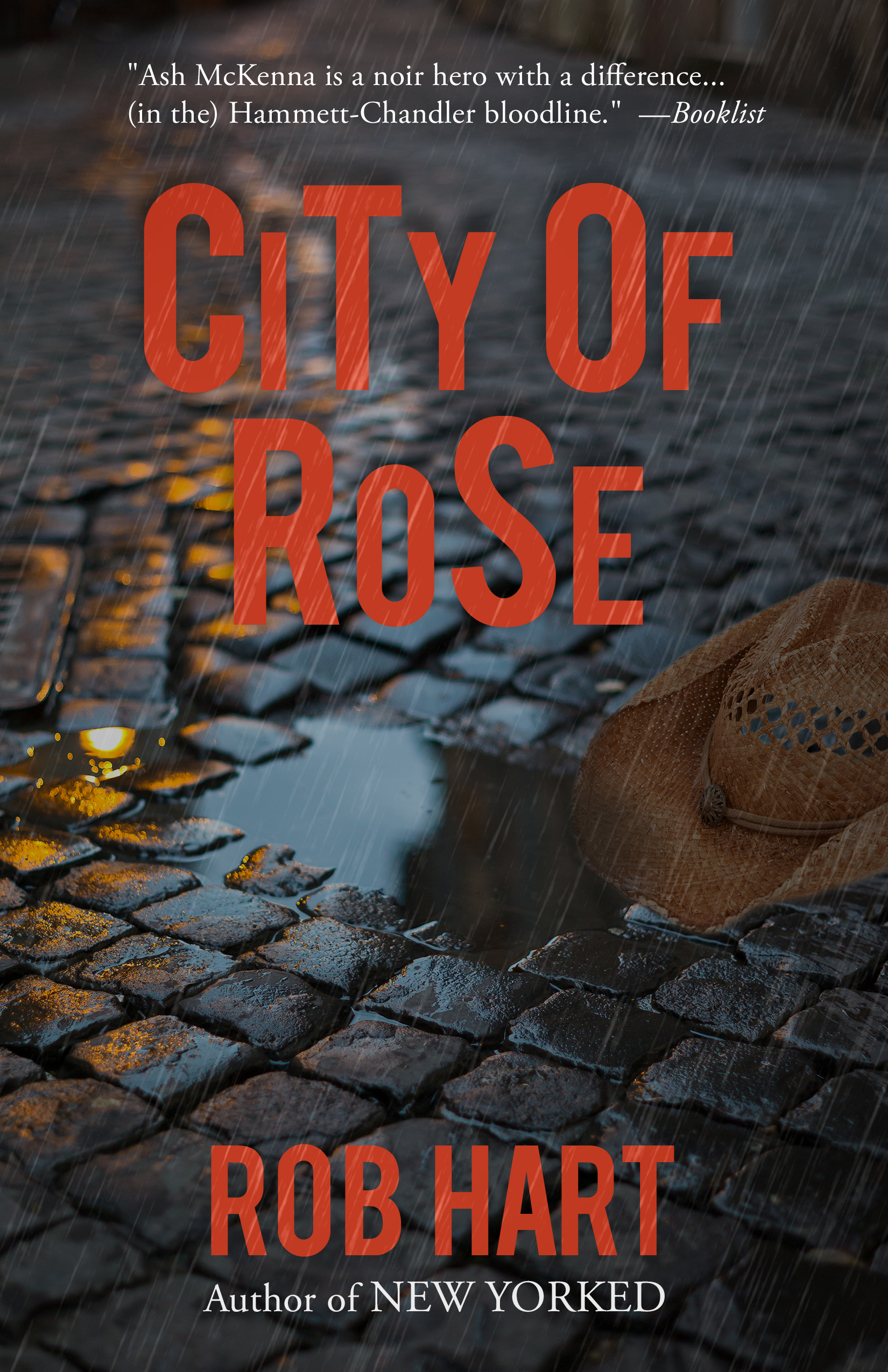
So for my second book, City of Rose, I knew I wanted a strong set of blueprints. The question was: How? There’s no one right way to outline. So I took a couple of tries, sketching things out, jotting down ideas.

Then I came across something that really worked for me.

I got myself a notebook, and I wrote up a list of characters. Then I went chapter by chapter, and wrote a couple of sentences for each one—the setting, what happened, how it would lead into the next chapter.

Once I was done, I trashed it. Ripped it right out of the notebook and threw it into the garbage can on the Staten Island Ferry.

A few days later, I did another outline. Characters, chapter-by-chapter breakdown. All from memory, all without referring to anything else.

I threw that away, too.

A few days later, I did it one more time.

That outline, the third one, I kept.

So, what’s with throwing away all this paper, you ask? Is it because of my deep-seated hatred for trees?

Yes.

No, wait. It’s because the second time I did the outline, I’d had some time to think. The plot threads marinated, the characters broke apart and reformed into stronger versions of themselves. I remembered all the things I was excited about, forgot all the stuff that didn’t really matter, and even came up with some new ideas along the way.

The third time was the charm. The final book isn’t exactly what I sketched out, but it’s pretty damn close. I wrote and delivered City of Rose within a space of six months. A far cry from the five years of New Yorked. And the best part of that is: I think it’s a better book.

Publishers Weekly seems to agree. In their review of City of Rose, they said “readers will enjoy [Hart’s] playful, jaded hero and twisty plot (happy face).”

It worked. Not to say any of this is going to work for you. Not every bit of advice is right for every single writer. But in the grand scheme of writing advice, I like to this this is a little more concrete than the often-conflicting stuff I’ve seen out there (write every day, write when you want, write drunk, write sober, write when the moon is in the seventh house…)

But if you’re the kind of person who feels like you need an outline, and the outline doesn’t always come together on the first pass—try not using the first pass. Junk it. Give it some time to gestate, then use the second, or third, or fourth, or hundred millionth.

Bonus round: I also found it helpful, after I finished the first draft of the book, to summarize each chapter on an index card, then sit with the cards and angrily stare at them while I drank a big glass of Jim Beam.

It was useful for seeing the breadth of the story, figuring out the pacing, finding where things happened too quick or too slow, etc.

Anyway. That’s me. That’s how I took a problem with the first book and fixed it the second time around. I’ve been doing this for all my new writing projects, and it’s really helped me feel like I’m proceeding on stable footing.

That is to say, the toilet ends up where it belongs.

What about you? Do you outline? Or do you write by the seat of your pants and hope you find the story in the process?

Do you have a process, different from this, that works for you?

* * *

Rob Hart is the author of New Yorked and City of Rose. His short stories have been published in places like Thuglit, Needle, Joyland, and Helix Literary Magazine. Nonfiction has appeared at Slate, the Daily Beast, Nailed, and the Powell’s bookstore blog. You can find him on the web at www.robwhart.com and on Twitter at @robwhart.

City of Rose: Indiebound | Amazon | B&N