Apple-Obsessed Author Fella

Category: The Ramble (page 183 of 478)

Yammerings and Babblings

25 Reasons Why I Stopped Reading Your Book

I don’t read novels like I used to.

I want to, but can’t. That’s for a lot of reasons — for one, it’s time. I write a lot. I have a five-year-old. Life intrudes. My reading is also broader, now. Writing comics means I read more comics. I also do a lot of research and read non-fiction — more non-fic than fic, I think. The other thing, though, is that I know how the sausage is made. I know because I make it every day. My hands are unctuous with narrative pigfat. I find that as you do a thing more and more, you become more persnickety about that overall thing. Example: there’s a farm-to-table ice cream place not far from us, and the owner has very strong opinions about ice cream. Who gets it wrong, who gets it right, what techniques are best, or laziest, or who is sexier, BEN or JERRY. I don’t have those kinds of strong opinions about ice cream because fuck you, it’s ice cream. Bad ice cream is better than no ice cream. Shove it in my bone-cave. All of it. NOW PLEASE.

But! I have strong reactions to novels. Stronger than I used to. I’m like a stage magician where it’s harder to fool me with your magic because I know all the tricks. I can see the misdirection coming a mile away. That means I probably start and put down four novels for every one that I pick up and finish. I don’t throw those first four down in rage before urinating upon them. I just quietly set the book aside, say “This book is not for me,” and then I urinate on it. No rage at all. Only smug beneficence paired with my steaming asparagus pee!

Kidding, kidding. No pee.

But I thought, okay, it might be interesting to unpack a little bit why I pick up some books and then put them down after five, ten, thirty pages. This is true of manuscripts both published and unpublished. And it’s important to note here that none of what I’m about to say is gospel. Some of these books reached shelves. Many of these books do very well despite what I’m telling you here. Which is to say, the list of reasons I’m about to give are intensely personal to me and not in any way good guidelines to follow. Why even include them? First, because I want to unpack it for my own curiosity (and this blog is for me before it is for you), and second because maybe the conversation will trigger something in your thoughts about your own work, or it’ll inspire some interesting and spirited conversation in the comments below.

(I encourage you to use the comments to answer the question: what makes you put down a book?)

Let’s begin.

1. I just don’t want to read it. This isn’t a helpful comment by any stretch of the imagination but it’s vital I get it out there — sometimes, I pick up a book, I start a book, and it’s a puzzle piece whose nubbins and divots don’t line up with mine. Book’s not for me. I’m not for it. End of story.

2. I have no context. None. Zero. Crafting the first thirty or so pages of a book is itself a vital and elusive art. You are required to pack so much into so little while at the same time not overdoing it. But the greatest thing missing from too many books is context. Books that begin with characters just doing shit or saying shit or thinking shit are fine — but from the first page, I want context. I don’t need all the details, but I need some sense of what’s going on and why. I need to be rooted in the story fast as you can get me there. You can meander, but goddamnit, meander with purpose. I need to know why you’re writing it, why the character is here, and why I should give a hot cup of fuck in the first place. This isn’t easy to do! Writing those early pages is a combat landing in terms of narrative — you’ve got to pull us all the way from the atmosphere to the ground in a thousand words. It’s hard, but WE NEEDS THE CONTEXT, PRECIOUS. *gums a fish*

3. Another thing I need that you’re not giving me: stakes. This is tied into the context. But if I don’t know the stakes — what can be won, what can be lost, what’s on the table — then why am I reading? Why are we here? Where are my pants?

4. Too much action. Once again, this is tied a little into the context problem, but I really hate books where I start them and suddenly we’re thrown into BULLETS WHIZZING AND KARATE WHALES AND A THOUSAND CREAMY PASTRY NINJAS and it’s five pages of cool-ass katana action and yet I have no idea what’s happening. Every punch is clear as day, but the motivation behind the scene or sequence is invisible. Realize that the mechanisms for resolving conflict are not the same as the conflict. A fistfight is not a conflict. Why they’re punching the beefy fuck out of each other? That’s the conflict. Jealousy. Stolen property. Revenge. Whatever. Conflict is the reason behind the fight, not the fight itself.

5. The book is all surface. A story isn’t just one thing. It can’t just be what you see, what you read — it has innumerable added layers, all invisible but still keenly felt. Like, okay, consider a sports car. The fanciest fastest motherfucker you can think of. The love child of a Lamborghini and a SR-71 jet. That car isn’t a model. It’s more than its frame and its paint job. Some of the interior you can see: seats, dashboard, steering wheel. Some parts you can see only if you look hard: the engine under the hood, the dead guy in the trunk. (I know cars like that don’t have trunks you can use to store dead bodies, but just play pretend.) Other parts will never be seen by you: the engine’s deepest interior, or the endless human and machine hours put into designing the car and the engine and the experience of the car. The car is more than just its function, too. It has style. It has a vibe. Designers don’t just plunk down a seat thinking, WELL THE DRIVER NEEDS TO SIT. It’s that, but then it transcends function. It becomes, how do we want the driver to feel? How do we want him to look in his own head and to other drivers? The car has a theme, a mood, it has a message. Your story is like that — or, it should be. It can’t just be CHARACTERS SAY SHIT AND DO SHIT. That’s there, but it’s just the paint job. A story operating without deeper layers is a shallow narrative, and I ain’t got time for that.

6. The characters all sound the same.

7. The book starts off too, um, genre-shellacked. What I mean is, if it’s sci-fi, it’s loaded for bear with bewildering sciencey stuff, or if it’s fantasy it’s all funky names with magical apostrophes, or if it’s horror it’s more interested in soaking the pages in raw, red gore and horror tropes. Context is king, yet again. Character is everything. Root me in the character. Make me care. Then layer in the genre elements. It’s like a cake — it’s easy to make icing taste good, but too much of it is gross. (Don’t tell this to my son, who will vacuum the icing into his maw while discarding the cake part. The little barbarian.) The cake is the foundation. It’s what holds up the rest of the stuff. Cake is character, character is cake. Now I’m hungry. I want cake. Someone get me cake. YOU THERE IN THE THIRD ROW. CAKE ME. NOW.

8. Speaking of genre, I’ll put a book down if it feels too samey-samey. It’s not that you can’t do interesting things with well-wrought tropes, but usually, I can tell when you’ve performed the narrative equivalent of a Human Centipede — where you digest one kind of fiction and then excrete that fiction back out into the world. It’s like Taco Bell — you’re just renting it and returning it to the ecosystem without actually processing it. I’d rather you make the genre yours. I’d rather you read more broadly and bring outside influence to the work.

9. No voice at all. This is a personal preference, to be clear — some readers want an author who disappears into the background. I don’t. I want the author to emerge a little, like a shadow in the rain. Sometimes that means word choice or sentence construction or rhythm. Sometimes it’s in the themes that present themselves. The book isn’t ALL YOU, ALL THE TIME, but I still want to see your bloody fingerprints at the margins of the page. I’ll put it this way: Dan Brown’s work is, to me, about as cardboardy as it comes. No harm or foul, because hey, his books are whiz-bang successes. But then you look at someone like Stephen King, whose work always reads like Stephen King. His ease of storytelling doesn’t betray his voice. Daniel Jose Older’s work feels like Daniel Jose Older’s work. Victoria Schwab’s work feels like — drum roll please — Victoria Schwab’s work. (I like these authors because when I read their work, it’s not that I know what I’m in for, it’s that I know I’m in the company of a capable, confident storyteller. Some authors view this as a brand, but a brand is about a pre-existing set of chosen permutations — a brand is about comfort. I want voice. I want to trust in the story even as it brings me discomfort.)

10. Too much voice will kill my interest, too. Comes a point where you gotta get out of the way of your own story. (Again: Stephen King is amazing at this. His work feels like his work, but he’s also not tap-dancing in front of the tale — he sits very comfortably behind the curtain.) Your story isn’t a stunt. It isn’t a stage. You’re playing drums, not playing lead guitar.

11. I’m bored. I get bored easily, to be clear. In this day and age, I’ve got a lot of very dumb stuff competing for my attention and I fall prey to it too easily — it’s a lot easier to check Twitter than read a novel. People could read a book, or they could hunt Pokemon. At the same time, though, I don’t think it’s an unfair ask when I say it’s important a story be interesting. One of the most vital goals of a storyteller is to capture attention. It’s like trapping a fly in a cup. It is necessary to be able to — from the first sentence — snap your fingers and hypnotize me with the tale at hand. And that means being interesting. The question of what’s interesting, however, is a many-headed, snarly beast, but at the very least, look to how one tells a story in person. Think about how you would keep people’s attention. How would you spark their interest? How might you give them just enough to keep listening? Worry, danger, conflict, desire. Imagine telling a story in such a way that if you just quit in the middle of a sentence, you’d leave people hanging with a HOLY SHIT WHAT HAPPENS NEXT look on their dumbfounded faces. Write a book like that.

12 . The balance of mystery is off. Mystery is tricky. Every mystery is a question mark, and as I am all-too-fond of repeating, a question mark is shaped like a hook for a reason. It sticks in you and pulls you along. But too many question marks and you’re pulled into asplodey viscera like that guy from Hellraiser. We need mystery early on — little mysteries that tease us forward without overwhelming. Or one big mystery that will cast its void-like shadow over everything. We still need a rope to feel for in the dark, though — something we use to pull ourselves a long. Too many questions, too much mystery, and we feel lost. We have no rope, no anchor. We have only hooks and darkness. And also cake. What I mean is, I’m still hungry for cake, you bastards.

13. Not enough cake in your story.

13. Fine, here’s a real #13: JESUS GOD THIS BOOK IS SLOW. I don’t need every book to have thriller pacing, though I admit I do prefer a snappier, zippier narrative. But while I do not require your book to read like it’s duct-taped to the back of a cheetah fixed with some manner of rectal rocket, I do want to feel like we’re getting somewhere in a way that respects the story and respects the time of the reader. Some books I read I feel like that stormtrooper on Tatooine — “Move along, old man in a landspeeder. Go on, just go, c’mon. Vertical pedal on the right, Grandpa Kenobi, chop-chop.” A story is liquid. A story moves. It doesn’t need to be a raging rapids, but don’t let it be a stagnant puddle. That’s how you get mosquitoes.

14. The story is too busy, too early. Cleave to simplicity. Simple goals are better than complicated ones. You can build up to bigger conflicts, but at the fore, think conflicts that are primal, that are easily parsed by the largest number of us. A lost child. Revenge for a death. Grieving over someone gone. Broken love. Simple, forthright things will grab us and root us. Common, fundamental problems are key — then you can spin them in whatever way fits the story (A DRAGON WANTS REVENGE ON A LIVING STARSHIP BECAUSE IT KILLED HIS ROBOT LOVER). Start small. Begin simple. Complexity comes later.

15. Also, this is true with language, too. If your book’s language is muddy or bombastic, I’ll check right out. Aim for clarity above any kind of GRAND MAJESTY OF THE HUMAN TONGUE. You’re not trying to impress us with frippery. Writing is a mechanism. It is a means to an end. Writing conveys more than itself. Writing is a conveyance for story, for idea, for character, for theme, for vision. Seek substance over style. Pursue precision in language over a noisy parade of words.

16. The character has done something I hate. And this is a weird thing, because it’s not a character’s job to be likable or to perform actions perfectly in line with my own morality, but if by page five I find out he’s a puppy-kicking baby-shitting rapist, I’m done. Sorry. Maybe this is a tale of his redemption or maybe you just want me to empathize with this horrible person, and that’s fair. I’m just not going to do it. I don’t need characters to be likable. I do, however, need them to be livable — meaning, I need to find some reason to want to live with that individual for 300+ pages. Some things are dealbreakers, though, and a character who is too vile or somehow unredeemable by my own metric… then I just can’t stay in the story.

17. Whoa, way too heavy a hand with the worldbuilding, pal. Ease back on the infinite details, okay? The worldbuilding should serve the story. The story is not just a vehicle for worldbuilding. I want to eat a meal, not stare at the plate. The plate can be lovely! You can work very hard on the plate. But not, I’m afraid, at the cost of the food that sits upon it.

18. Similar to the above? Your book has way, way too much exposition. Exposition is not the devil. We like exposition… ennnh, within reason. I like to treat exposition as if it’s a dirty necessity. It is an unpleasant act that must be fulfilled — it is, in a way, like air travel. Nobody likes air travel. These days, air travel is basically just SKY BUS, full of as many dubious weirdos, like that guy who keeps taking off his shoes, or that other guy who sweats hoagie oil, or those people who were somehow allowed to bring on a Tupperware tub of warm sauerkraut. But if you wanna get to that place you wanna go: you hop on the plane and you get it over with. Exposition is an act that is best served by figuring out how little of it you can get away with while still serving and continuing the tale. Get in. Get out. Get it over with.

19. OH MY GOD I AM BEING CRUSHED BY THESE WALLS OF TEXT. Stories are beholden to rhythm. Short sentences, long sentences, diverse paragraphs, mixed-up word choice. But if I open a book and it’s just one epic paragraph after another, after another, after another, my eyes start to become tired. I pee myself and pass out. It’s not a good scene.

20. I’m confused. No idea what’s happening. Have to keep backtracking to find out.

21. I gain no sense of why now? Every story you write should begin with that essential question: why is this story happening now? If we are to assume that a story is a break in the status quo — and to my mind, stories are exactly that — then the timing of the story is vital. What precipitated the narrative? What events inside the story make it necessary, and necessary at this moment? Did someone just steal the Death Star plans? Is this a Christmas party set in a building just as German terrorist-thieves are about to initiate an, erm, hostile takeover? Has there been a wedding? A funeral? A discovery? An attack? HAS THERE BEEN AN AWAKENING AND HAVE YOU FELT IT? Some stories lack an answer to that question, why now, and I can feel it. It undercuts the urgency of the tale. And urgency is everything. Creating urgency makes the story feel vital and it keeps people reading. (Lending the narrative that urgency is a lesson unto itself, of course.)

22. Not enough sodomy. Okay, just seeing if you’re still reading. But seriously: cake and sodomy.

22. Okay, real #22 — the plot exists outside the characters. They do not control it. They do not contribute to it. Nobody is directing it but you, the Overarching God-Author. You’re like a railroading DM who has the adventure set one way and any time the party wants to try something different (“We’d like to make friends with the Demogorgon!”) you short-circuit and punch the plot to do what you want it to do, not what feels natural to the characters, their motivations, and their actions. Plot should be internal, growing into the narrative like coral, like bones, but yours is external: it’s all exoskeleton, all scaffolding.

23. The plot exists only because of stupid, wrong people and their very bad, very stinky decisions. I’m not saying characters cannot and should not make mistakes. Characters needn’t — and shouldn’t — be perfect. But if the plot only exists because they’re jerky dumdums who just make jerky dumdum decisions, then ennnnyyeaaaah not for me. I prefer you treat your characters as if they’re all intelligent with respect to their own worlds. That doesn’t mean high-IQ. It doesn’t mean a plumber knows how to build a fucking teleporter. It just means within respect to their own life and experience they have some smarts going on.

24. Your characters aren’t acting like people. They’re acting like plot devices. This is related to #22 and #23, but what I mean is, you can feel how they’re acting against logic and their own emotional intelligence to further plot points. They keep secrets when keeping secrets is neither prudent nor interesting — it’s just that the secret is what keeps the plot alive. They lie when it makes no sense to lie. They perform actions like the victims in the horror movie, just stumbling into danger because they need to die to chain to the next scene in the sequence of events.

25. Everything is just a series of scenes. Scenes need to connect. They are bound by a throughline. But yours just feel like disconnected bits — vignettes and moments and setpieces that have been placed next to each other but given no connection. They are rooms without doors or windows.

* * *

INVASIVE:

“Think Thomas Harris’ Will Graham and Clarice Starling rolled into one and pitched on the knife’s edge of a scenario that makes Jurassic Park look like a carnival ride. Another rip-roaring, deeply paranoid thriller about the reasons to fear the future.” — Kirkus Reviews (starred review)

Out 8/16. Preorder now:

Indiebound

Amazon

B&N

Macro Monday Is A Fun Guy

Get it? Fun guy? Fun gi? Fungi? Mushroom?

SHUT UP

DON’T JUDGE ME

*runs crying into the bathroom*

*slams door*

Anyway.

Short post today. Gotta hit the pavement running and crank out some more of the VENOM AND WHISKEY blend that is Miriam Black, book five. Next week is Invasive and I’ll have a cool TAKE A PHOTO WITH YOU AND INVASIVE AND WIN SOME STUFFS contest coming up next week. (Preorder Invasive now, if you so desire: Indiebound, Amazon, B&N.) Ooh, also, Crimespree Magazine did a review of Invasive here, and said of it:

Invasive is one part locked room mystery, one part 1950’s monster movie, and one part cutting-edge scientific thriller… The story twists and turns like the hiking trails that circle the island. Hannah Stander is the world’s only hope for survival against an unspeakable horror…”

Pop Culture Beast said of the book:

“Wendig has outdone himself with Invasive. It’s a creepy crawly masterpiece of suspense and genetic horror.”

Also, if you’re not watching Stranger Things, go watch Stranger Things. It’s far from a perfect show — it occasionally dips into PLOT OVER CHARACTER territory and sometimes fails a few of its women characters — but it is the closest thing to a Stephen King novel translated to television. We haven’t seen the final episode yet, but ye gods, is it a spooky delight.

Flash Fiction Challenge: The SubGenre Blender Spins Again

IT IS TIME ONCE AGAIN. We shall force subgenres to have little story babies.

I will give you 20 subgenres. You will pick two from the list either using a d20 or random number generator (or use tea leaves or badger guts or something), then you will write a short story that mashes up those two subgenres.

Length: We’ll say 2000 words.

Due by: Next Friday (8/12), noon EST.

Post at your online space.

Link to it in the comments below. So we can all read it!

THE SUBGENRE LIST:

  1. Kaiju
  2. Cli-Fi (Climate Change Fiction)
  3. Gothic
  4. Shapeshifter
  5. Weird West
  6. Fairy Tale or Fable
  7. Body Horror
  8. Sword & Sorcery
  9. Whodunit?
  10. Military Sci-Fi
  11. Comic Fantasy
  12. Creature Feature
  13. Superhero
  14. Bodice Ripper
  15. Heist / Caper
  16. Magical Realism
  17. Parallel Universe
  18. Noir
  19. Time Travel
  20. Musical

Hayley Stone: Five Things I Learned Writing Machinations

The machines have risen, but not out of malice. They were simply following a command: to stop the endless wars that have plagued the world throughout history. Their solution was perfectly logical. To end the fighting, they decided to end the human race.

A potent symbol of the resistance, Rhona Long has served on the front lines of the conflict since the first Machinations began—until she is killed during a rescue mission gone wrong. Now Rhona awakens to find herself transported to a new body, complete with her DNA, her personality, even her memories. She is a clone . . . of herself.

Trapped in the shadow of the life she once knew, the reincarnated Rhona must find her place among old friends and newfound enemies—and quickly. For the machines are inching closer to exterminating humans for good. And only Rhona, whoever she is now, can save them.


*** 

When Something’s Wrong, Fix It

Full disclosure: I’m a pantser or, as the cool kids call it, a discovery writer. I begin my stories without any or very little idea of where I’m going, and what will happen. This suits me because I like the experience of a story unfolding before me in a spontaneous, fluid way, getting as near to a reader’s perspective as possible. Of course, it also forces me to rely on my gut a lot of the time. Which is totally cool and never causes any problems.

Oh, wait. No. The opposite of that.

Being a discovery writer is all about instinct — knowing when something is working, and when it’s not. Example: Machinations features a small, barely-there love triangle. In the first draft, it was much more prominent and complicated, but even still I went in with a good notion of who I wanted the main character, Rhona, to end up with. Rhona had other ideas.

Even before I typed the last words, I knew I was on the wrong track. I had the niggling feeling that I was forcing it. But I was already committed; I’d written so many words, you see. Surely I could spin this resolution without having to do a major rewrite? Turns out, my doubts had weight, and I later had to do a lot of rewriting to fix the romantic subplot.

I know a lot of writing advice cautions against rereading and editing while working on a first draft—and sometimes rightfully so—but for myself, it’s impossible for me to move forward when I know there’s a mess behind me that I’m going to have to clean up later. Since then, when I’m certain something is wrong and I have a good idea how to fix it, I simply go back and do so. Saves a lot of heartache down the line.

Muses Are Fickle, But Discipline’s a Bro

There’s a reason a lot of professional authors recommend keeping a consistent writing routine: because it freaking works.

My daily word count goal while writing Machinations was 1,000 words (500 minimum, if I was feeling really off or had to revise). It took me about five and a half months, I only maybe missed a few days here are there, and often wrote more than my goal. Part of the reason I worked so stringently was because I was trying to prove to myself that I could write a novel without the high-intensity challenge and excitement of NaNoWriMo (which, previously, had been the only time I’d finished a novel).

Passion and inspiration are great to have, and necessary to begin, but on the days where the doubt is crippling, habit and discipline will get you through more than some imaginary Grecian goddesses.

Word Count Ranges Exist For a Reason

Come with me, if you will, on a brief journey to my early querying days…

[Insert wavy flashback transition]

Thoughts, at the time of initial querying, c. 2012: yes, your book is outside the typical word count range, but you are a special snowflake and this story is so good and there’s not a single thing you can or should cut. Agents will definitely overlook the fact that you’re 15,000 words over what is generally acceptable for debut authors in your genre. I mentioned the snowflake thing, right?

Reality: Form rejections.

I can’t know for sure, but I suspect a lot of my early rejections were based off the book’s lengthy word count. More to the point, later when I finally decided to roll up my sleeves and axed over 16,000 words to bring it into an acceptable range, I found that it improved the pacing of the story drastically and tidied up some character arcs. I also started getting full requests from agents.

The moral of the story? Don’t hold on so tightly to your words and pride that you’re unwilling to whip the ms into the shape it needs to be in for readers.

(There are exceptions to adhering to word count ranges, of course; a good story always trumps everything else. Still, if you’re over, it might be a good idea to take another look and see if that chapter where your MC takes a long walk and ponders the nature of existence is really necessary to the plot.)

Just Because It’s Hard Doesn’t Mean It Isn’t Worth Doing*

For about a year and a half after finishing the first draft and my aborted querying attempt, I left Machinations alone to collect proverbial dust, consigned to the oblivion of my hard drive. I was convinced it would become another “trunk” novel. Not because it wasn’t any good—friends agreed that it was fun and entertaining—but because the effort involved to fix it, to make it good enough to appeal to agents… well, it seemed like too much work.

I’m embarrassed to admit that now, but at the time, I had all sorts of justifications for setting the manuscript aside. It wasn’t “hard” enough for sci-fi. The voice wasn’t mature enough. I would do better with my next story. Blah blah blah…

So often it seems much easier to move on to a fresh project than tinker around with an old one with all its flaws. New ideas always look incandescent, full of promise, whereas once you’ve put actual words on the page, a story becomes chained to the hard reality of art. No art is perfect, because perfection doesn’t exist. (The saying “art is never finished, you’re just finished with it” also comes to mind.)

Maybe leaving Machinations alone for so long gave me necessary perspective on the story, enough to make the edits it required when I finally returned. Maybe I wasted time. I certainly didn’t complete another novel in between, though I tried. Either way, I eventually toughened up, got in there, and revised. And revised. It wasn’t easy, but it was worth it.

* I stole this expression from my grandma, but don’t worry. She’s cool with it.

My English Teacher Was Wrong (And Yours Might Be, Too)

Two of the most damaging beliefs I ever received about books came from an English teacher I had in high school. The first was, “If you know every word in a book, it’s beneath you.” And the second was, “If it’s entertaining, it’s not good literature.

Not coincidentally, that’s also what my inner editor sounded like throughout drafting Machinations. Along with pointing out punctuation and grammar errors, my inner editor laughingly questioned whether my book would be considered “good literature” because it featured so much humor, because it was bright and fun and—gasp!—entertaining.

True: Machinations isn’t high-brow. It won’t make you go to the dictionary every other page—but so what? That’s not the instrument by which I measure a good book, and it’s not the book I wanted to write either. I wanted to write an adventurous, character-driven story that asked big questions about love and identity. A book readers could enjoy and come away feeling good about by the end.

It took me a long time to drown out that teacher’s voice and see the worth in what I was writing. And you know what? With all the darkness in the world today, I think creating fiction that allows people an escape hatch from the real world is as noble a goal as any.

***

Bio: Hayley Stone has lived her entire life in sunny California, where the weather is usually perfect and nothing as exciting as a robot apocalypse ever happens. When not reading or writing, she freelances as a graphic designer, falls in love with videogame characters, and analyzes buildings for velociraptor entry points. She holds a bachelor’s degree in history and a minor in German from California State University, Sacramento. Machinations is her debut novel.

Hayley Stone: Website | Twitter | Facebook | Tumblr

Machinations: Amazon | Barnes & Noble | Kobo | Goodreads

Slaying The Dragon: Social Media For Writers, And What That Means For The Success Of Your Book


the fuzziest, happiest dragon you ever did see SHUT UP SHE IS TOO A DRAGON

I said a thing last year about social media being a misunderstood opportunity for writers and blah blah blah social media is about connecting and not selling.

You should go read that.

Because I’d like to expand on it a little bit.

Writer Christa Desir tweeted from a conference that Random House gives its authors a social media grade, which is to suggest that social media is important to a writer’s existence. (I for one would like to know my social media grade. Also my liquor consumption grade, my self-doubt score, and the percentages that show just exactly how much of an impostor I actually am. GET ON THAT, PUBLISHERS.) I have no idea if this idea is in any way malevolent or misguided on the part of the publisher — I’ll go ahead and be optimistic and assume that the grade is not to judge or diminish an author but simply to show authors who might could use a little coaching on social media. Because on social media you can do some good or you can do some ill-ass evil, and hey, maybe it’s a good thing to help people understand what it means to be a writer-person in the online world. (Thanks go to Christa for putting this stuff out there, by the way, because this one of the ways that author social media is best: writers sharing information with other writers.)

Anyway.

I’d like to say some things regarding writers hoping to use social media to sell books and expand their audiences — well, first, I’d say that please do realize that every friend or follower is also not a 1:1 reader. Meaning, they read your tweets, not your books. They may eventually come over to reading your books, or they may have started as a reader of books and then segued into being a reader of tweets, but it’s not an automagic process. People don’t follow you on Twitter or Instagram and suddenly become MINDSLAVES TO YOUR WRITING. Your words are not a meme-based parasite that drives them to seek your words in other quantity. (I’m working on that, but so far the science has failed me.) Often enough, though, we pretend this is the case. That social media success is the same as book success, or that one follows the other, or that they’re intimately connected — two forces cosmically joined in word-squishing fornication.

The success of your book does not rely upon social media.

And the success of your social media does not rely upon your book.

The two flirt with each other. But they are not perfectly bound.

I’d like you to consider the success of your book in RPG (role-playing game) terms.

As someone who has played many an RPG (in paper and on screens) and who has written them, too, I actually think that RPGs inadvertently model life’s many progressions fairly well — not in a literal way, but in a metaphorical way, which is why I say “model.” RPGs provide a kind of framework for thinking about how we interact with the world and how we move through it, gaining cool new kung-fu moves as we go along the way. (I’ve long thought that writing a non-fiction book about Life Lessons Gained From D&D would be a cool project.) Part of this is that much of life is down to luck. Life is down to random chance, to a confluence of atoms, to lots of coincidences big and small elbowing into one another. But luck isn’t dumb. Luck is smart. You can actively pursue luck. It’s not roulette, where your choice is literally up to the whims of the universe. It’s poker — where you take the cards you’ve been dealt and then you make decisions and take actions based on those cards in order to maximize your chances. In some RPGs, luck is literally a stat. You can use it in a variety of ways to help achieve your goals.

So.

Let’s say that over there is a dragon. This dragon represents the success of your book.

You want to slay that dragon. That is the task before you. Slay the dragon and then slit his belly and gold comes pouring out because, I dunno, this dragon eats gold, shut up. The gold is a royalty from your book sales. Dragon dead. Book a bestseller. Huzzah and hooray, let’s go to the tavern and get fucking sloppyshite on Kobold Piss Whiskey and Dwarven-Forged Ale.

In game terms, the way you mechanically slay a dragon is you have an attack roll — you roll one or several dice and the dice determine if you hit. Your dice are likely modified by your skills, and they are likely modified by the weapon you hold in hand. You make one or several attack rolls to murder that dragon, because apparently the greatest desire of a fantasy traveler is to fuck up a poor, gold-eating dragon, you monster.

Generally, in games, you have various ways to modify that roll. You cast a spell on you or your weapon. You train your skills. You sharpen the blade. You spend some kind of expendable resource (Willpower, Luck, Confidence, whatever) to add dice or numbers to the roll — all in order to increase your advantage in order to slay the dragon. Your success is ultimately still random, right? You try and you win or fail based on the whims of the dice. Ah! But, you do these things in order to increase the chance of your success and reduce the chance of your failure.

Now, you pretty much need some kind of weapon to slay the dragon. You might be able to use your bare hands and punch the dragon to death, but if that’s your strategy, I’m gonna go ahead and assume you have an incredibly low chance to hit and an incredibly high chance of the dragon burning you to a glob of charred fat before promptly shoving you between two horses and gobbling you right up (for this is the dragon’s favorite kind of sandwich). Your chance of success via DRAGON-PUNCHING is so low it is approaching zero. Sure, you probably heard tell of some guy who did it, but that guy is not your model, he is a MYTHIC OUTLIER.

So, assume you need a sword.

In book-writin’ terms, that sword is your book.

You can go into dragonbattle with a shitty wooden sword — a fucking crap-ass book, in other words — or you can go into battle with the best goddamn sword you can muster, which is to say, the best goddamn book you can write. But you need a sword. You need a book.

Having a great sword is no guarantor of beating the dragon. But it ups your chances. And having a great book offers no guarantee of that book being a slam-bang success — oh, if only it were. Many books are published that are great… and they suck the pipe before taking a big ol’ dirt-nap. Many books are published that are terrible and those books end up as New York Times bestsellers. (This is where someone chimes in: LIKE YOUR BOOKS, SUCK WENDIG, and then we all have a merry chuckle before I command the dragon to eat your ass like it’s a goat salad.)

You can, as a wannabe dragonslayer, do things to up your chances of doing more damage — like I said, cast a spell, sharpen the blade, whatever. And you can, as a wordslinger, up your chances of making your book a success. One of the things that provides a positive modifier to your book-publishing dice roll is engaging with social media in a positive way. And that can mean whatever it means. It may mean engaging with fans in a cool, not shitty way. It may mean sharing things you love. It might mean just being funny and sincere and the best version of yourself. It means, most likely, occasionally promoting yourself and your book without then hitting people in the mouth and crotch with the news of your book. (Note too that social media can also end up as a negative modifier — if you are a super-shitty-dick-person on Twitter and you shellac the social media frequencies with your smug spunk and a sheen of fermented crappiness, there is a very good bet that you have just harmed your chances at your book succeeding.)

There exist a few important takeaways here —

First, social media modifies the blade — but it is not itself the blade. I’ve heard tales where people have gotten book deals based purely off their social media followings and have maybe even found success that way. Like the knight who wanted to punch the dragon to death, assume once again that what you’re looking at is a MYTHIC OUTLIER. (Our writing careers will be filled with tales of mythic outliers — authors who credit random tasks as the progenitor of success, as if the results of those actions were JUST GOOD OLD-FASHION WISDOM rather than the product of divinely-inspired luck. We saw this to a degree with the tide of self-publishing: those who found success there were suddenly building churches to the cause rather than accepting that what they did was just one way up the mountain.)

Second, modifiers are non-essential components. All you need are YOU and the SWORD. Yes, it’s not a bad idea to add modifiers — but what’s essential is the book, not the social media around the book. If you’re frantic about social media and how it effects you and your book sales, calm thy nipples. Also, not everyone is great at social media, so remember again it can become a negative modifier instead of a positive one.

Third, social media is not the only modifier available to you. Assume that a wide variety of things contribute: marketing, advertising, book cover, book description, shelf placement, and so forth. Plus, you’re also playing to unseen targets: cultural zeitgeist, for instance. Sometimes a book is a hole-in-one simply by dint of it speaking to some unrealized human frequency. Sometimes a book fails because it is out-of-sync with that frequency. But there exist other ways to modify, is my point. You needn’t rely on social media. And if a publisher wants you to rely on social media, you should cast that publisher a wary eye.

Fourth, and building off that last point…

One final and vital modifier to the DRAGONSLAYING BOOKSELLING dice roll is the huge modifier your publisher brings. Actually, it may be better not to view the publisher’s efforts as a modifier but rather as them bringing a whole dragonslaying party to the battle. With a good publisher and a strong effort, you are no longer alone in this fight. You’ve got an elf archer, a demon cleric, a dwarven accountant, a berserker baboon whose ass shoots lightning — whatever. Hell, a really epic publisher effort might mean you’re bringing an entire ARMY to bear against the dragon. Sure, the dragon might still eat every last one of you for lunch, but I’d rather go to dragonwar with a hundred knights than just me, a chainmail codpiece, and a steel blade. It’s your name on the book, so you get to look like the lone hero, but it doesn’t need to be that way in reality. (How this applies to self-publishers: you aren’t just the writer. You’re author-publisher. You bring to bear a team of people to the task, just as a larger publisher would.)

Go forth.

Write the book.

Slay the dragon.

Be the best version of yourself.

The end.

* * *

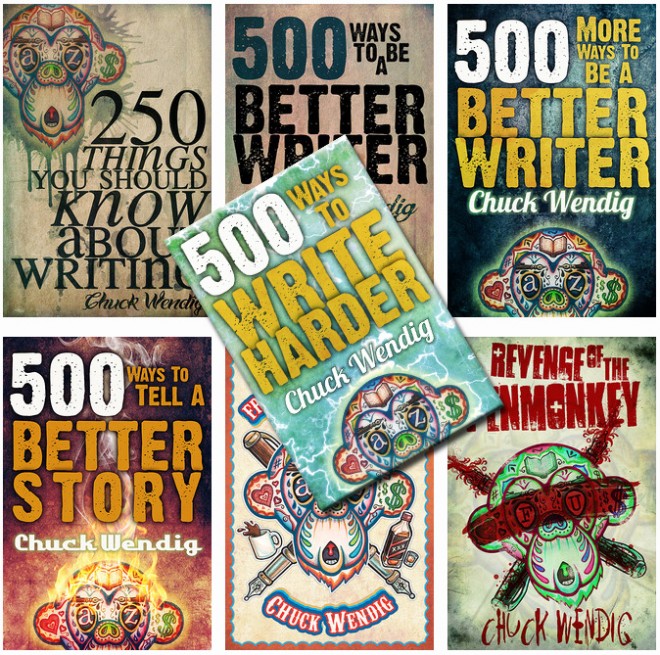
Gonzo Writing Book Bundle! Eight books. Normally $20.00, but with coupon code DRAGONPUNCHER, you’ll knock that cost down 25%, to $15.00. Sale runs until Monday, 8/15.

Macro Monday Needs A Drink

There you go.

*clink*

(That’s a Not Your Grandmother’s Greyhound from Bolete in Bethlehem, PA.)

Some quickie news spoogings, here and now:

Crimespree Magazine reviews INVASIVE, saying in part:

“INVASIVE is one part locked room mystery, one part 1950’s monster movie, and one part cutting-edge scientific thriller. All parts thrown together like a literary Swedish chef. The story twists and turns like the hiking trails that circle the island. Hannah Stander is the world’s only hope for survival against an unspeakable horror…”

Not only will I be doing an INVASIVE launch week event at Doylestown Books (8/17, 6:30PM, details here), I’ll also be helping relaunch Let’s Play Books in Emmaus on Thursday, Sept 22nd, at 7PM (deets hereand also the relaunch of Main Point Books in Wayne, PA on 9/10 at 2PM (deets). If you’re in the tristate area, I hope to see you at one of these. Also on launch week — I’ll be running a cool contest. With prizes. FOR STUFF. Get excited. No, I mean it, get excited. *stares at you until you get excited* *waits* *stares harder*

And hey finally — didja see, didja see? I’m a spotlight guest at NYCC’s book con this year! Ha ha ha! I continue to fool the world by convincing them I’m a legitimate writer! Suckers. Anyway. COME SAY HI.

And I think that’s it.

All the news that’s fit to print. Even though this isn’t print. It’s digital. Everything is digital now. I’m digital. You’re digital. THIS IS THE MATRIX OH GOD WE’RE ALL FOOD FOR BATTERY SPIDERS I need another drink